Pregnancy
The word 'tracker' hides three different jobs, and people mix them up.
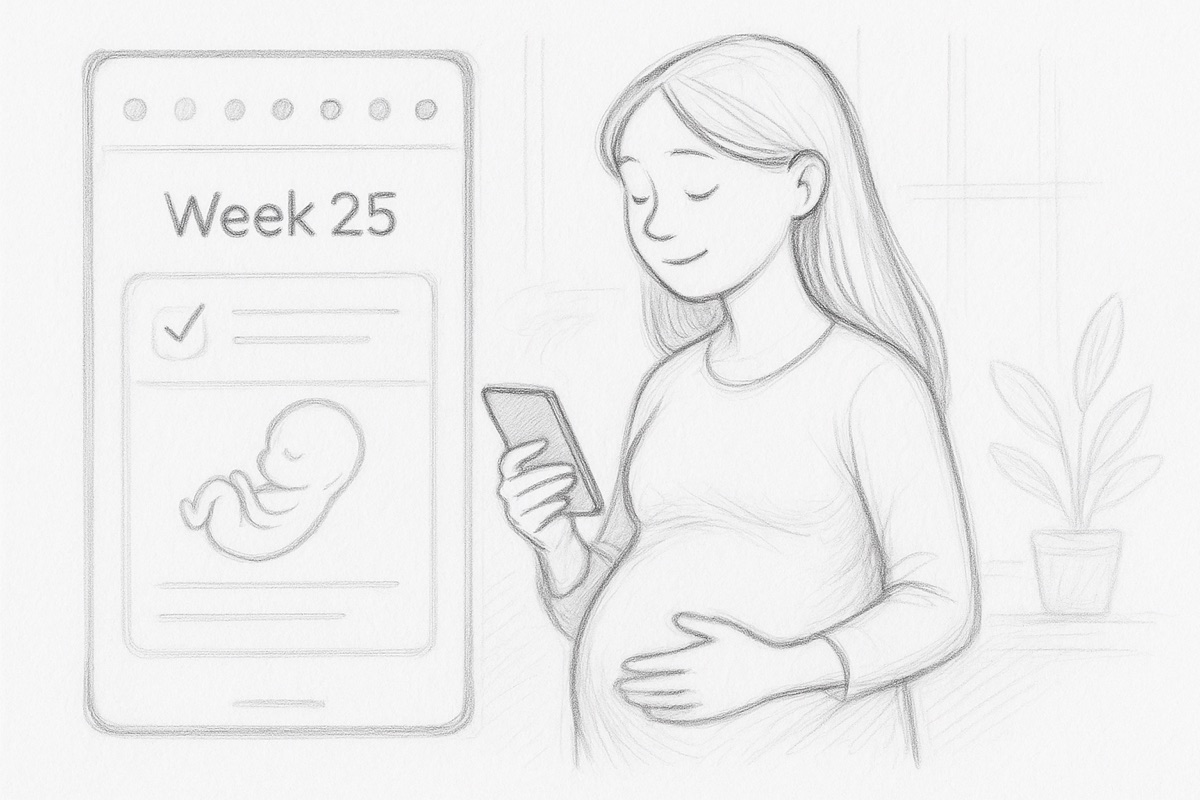
The most crowded one is the weekly journal (WTE, BabyCenter). What people buy here is one feeling: once a week, seeing what's happening with the baby. And here the leaders break on flat ground. The week counter runs a week ahead, can't be fixed, the app gets deleted.
After a loss, some erase it without a word (Ovia), others keep sending 'your baby can now do this.' The tone pushes: jabs about weight, fear about miscarriage.
The second job is an acute one-time tool, the contraction timer. Any obstacle here reads as mockery. The third, after the birth, is a shared log of feedings and sleep (Nara).
The market doesn't divide by price. Almost nobody offers a journal you can trust with your dates that won't wound you after a loss. Or an acute tool that simply works.
Market overview
The tone of the market is set by the big free content trackers: What to Expect, BabyCenter (72 with 292 thousand) and (48 with 38 thousand). Everyone else measures against them. And they are the ones women leave over ads, fearmongering and fights about wording. By honest quality the small products lead: Nara, (82 with 7 thousand), My Pregnancy (74 with 14 thousand). The couples niche is still tiny: has just 1,626 ratings and a realScore of 48.
- Size
- 1,337,771ratings across 43 apps · 12,896 reviews read
- Concentration
- 57%of all ratings held by the top three
- Downloads
- 80 M+installs across the top 11 on Google Play, led by Pregnancy + | Tracker App
- What people pay
- $60$3$30$2.99prices cited in real reviews
- Leaders
- Revenue estimate
- What the niche's top apps make a year. The number opens together with the ideas. Unlock
- Trust
- 18 of 43apps where the storefront star diverges from review text; this is a review signal, not proof of manipulation. 2 score above 80
- Discoverability
- 70 of 100a new app's chance to break in: the top three hold 57% of ratings, 7% of the sample has a large star mismatch, 8 score above 80Computed from leader concentration, gamed share, count of strong apps and demand size. Rough, order of magnitude.
- Money
- Who pays in this niche, for what, and why most players lose money. It opens together with the ideas. Unlock
The players come in three types. Big services on subscriptions and ads (WTE, BabyCenter, Ovia) win on reach, community and visuals. But they sag on reliability and tact: ads on top of the text, crashes, wrong week counts, indifference to loss. Small one-time-purchase apps (My Pregnancy, ) win on the opposite: ad-free quiet and simplicity. But they miss small things like editing the due date, dark mode, familiar units. Narrow apps do one job completely: contraction timers (), cosmetics ingredient checks (), prenatal exercise (Down Dog). The nastiest group is crude money grabs: Femia charges and won't let you cancel, and some services demand payment right in the middle of labor. There's also a debatable dads niche (): it wins because dad finally got invited, but sags on a goofy tone and falling out of sync with the wife's app.
Audience
"Pregnancy" is not one customer. Inside are different people with different jobs, and they pay very differently. First you choose who you build for.
Where the money is
Where users come from
Channels visible right in the reviews: people say themselves how they found the app and why they installed it. This is the niche's distribution.
Coming back with the next pregnancy7
The tracker gets installed fresh for every pregnancy, and people pick the one they remember from last time. The market restarts every couple of years, so winning the first pregnancy brings the second and the third, and a spoiled impression loses them forever.
I first saw this app when I was pregnant with my first child my son back in 2020. Then I got pregnant again with my daughter back in 2024 and I still have it today I'm pregnant again for a third time
Redownloaded for my second pregnancy just to find that there are ads everywhere now, and the interactive birth chart is now just a pdf and a blog post.
Word of mouth: girlfriends and family7
Pregnancy gets discussed with friends and sisters who've been through it, and the advice arrives together with an app name. It works for men too: dad guides get passed between future fathers.
Love this app, having my first baby and was recommended this from a close friend. It's pretty cool, love the checklist and all the info.
After being recommended to the app by my sister in law I was only on it for 3 weeks before I was randomly deleted.
Doctor's or insurer's orders5
The OB recommends a kick counter, the clinic or insurer hands out its own app for the benefits. The channel brings highly motivated users, but a mandated assignment doesn't forgive bugs: the person didn't come by choice.
My OBGYN recommended this app for counting my kicks. I've added my pregnancy so that I can view the full history of my kick sessions
Trying to login because my insurance told me to download this app for pregnancy benefits but won't even load to let me login.
Downloading mid-labor3
Contraction timers get installed at the last moment, sometimes literally in the delivery room. The decision takes seconds and rides on store search results, and a paywall or ads in that moment kill both the install and the rating.
We pulled this down from the App Store while my wife was in active labor.
I was looking for a free app and this one came up. But during my labor it literally didn't let me record my contractions and instead forced me to purchase a subscription.
Review-based rating
The same sample of 43 apps in two scoring systems. Switch to see how the storefront star aligns with what people write in reviews.
 Nara Baby & Pregnancy Tracker4.9 in store · rating aligns · 22,560 ratings82our scoreThe core value is that several people (husband, wife, nanny, grandparents) track one baby in one place: feedings, diapers, sleep, trends for the pediatrician visit, all free. It breaks on timers: after recent updates they glitch, do not stop from the lock screen, and sleep and diaper logs sometimes vanish. Notifications and family re-invites also let people down.
Shared access for multiple caregivers and nanny, free, tracking feeding, diapers and sleep, trends for pediatrician visits, easy even with postpartum fog
Glitchy timers after updates, timer won't stop from lock screen, sleep and diaper logs disappear, notification failures, app crashes, gets kicked out of family
For newborn parents who track the baby as a couple or team and want everything in one place for free.
 Full Term - Contraction Timer4.7 in store · rating aligns · 7,195 ratings82our scoreA no-frills contraction timer that genuinely helps during labor: people downloaded it mid-contraction and showed nurses the intervals. They love the lack of clutter and the kick counter, while most complaints are about the Apple Watch, where the start-stop button works only sometimes, and ads that pop up right during contractions. A few report a glitch wiping their collected data.
Simple timer with no frills, helps in labor and shows intervals to nurses, kick counter, daily reminder, free with cheap ad removal
Works poorly on Apple Watch, start-stop button fires only sometimes, ads pop up right during contractions, a glitch can wipe collected data, no editable list of times to fix mistakes
People who want one reliable contraction timer in labor without extra features
 Storky - Contraction Timer4.8 in store · rating aligns · 1,799 ratings78our scoreA simple free contraction timer that does one thing well: it tells you when to head to the hospital and doesn't bury you in ads or subscriptions. People value exactly the minimalism and that everything is free, unlike rivals that ask for money after 6 contractions. The weak spots are minor but annoying in the moment: you can't edit a contraction if you forgot to hit stop, the screen dims and throws off the count, and leaving the app freezes the timer and can lose data.
Fully free with no pushy ads, alerts when it's time for the hospital, dead simple and clear mid-labor, accurate per moms who gave birth, readable log
Cannot edit a contraction if you didn't hit stop in time, screen dims and skews the count, timer freezes when you switch apps, no Apple Watch, data lost on exit with no confirmation
Women in labor and partners who want a simple free contraction timer with no extras
 Prenatal Yoga | Down Dog4.9 in store · rating aligns · 13,711 ratings76our scoreIt replaces expensive classes and prenatal studios at home, and people praise the customizable vinyasa flows, choice of voices, styles, and levels tuned to the pregnancy stage and how you feel. It breaks on repetition: noticeably fewer poses and variations than the regular Down Dog, you can't like or exclude specific poses, and traditional practitioners miss transitions and intensity. Plus technical crashes, especially on iPad and with AirPlay.
Customizable vinyasa flows for stage and mood, choice of voices and styles, replaces expensive classes at home, calm flows for different energy levels, 2x Boost feature
Less pose variety than the regular Down Dog, can't like or exclude poses, too gentle for experienced yogis, crashes on iPad and with AirPlay, won't open after an update
For pregnant people who want to do yoga at home tuned to their stage and level, without expensive in-person classes.
 My Pregnancy | Tracker & App4.8 in store · rating aligns · 14,631 ratings74our scorePeople love the clean beautiful design, total absence of ads and pop-ups, and that it doesn't demand a lot of personal data, especially good for the first trimester. It breaks on two things: the app shows the week one ahead of the real one, and the advice section contains outright wrong information and fear-mongering in the third trimester. People ask for dark mode, notes, and images of moms of different ethnicities.
Clean beautiful design, total absence of ads and pop-ups, minimal data requested, clear articles, simplicity
Shows the week one ahead, wrong advice and fear-mongering in the third trimester, no dark mode, can't add notes, little diversity in images
For those who want a minimalist, beautiful ad-free tracker with no data grab, especially in the first trimester.
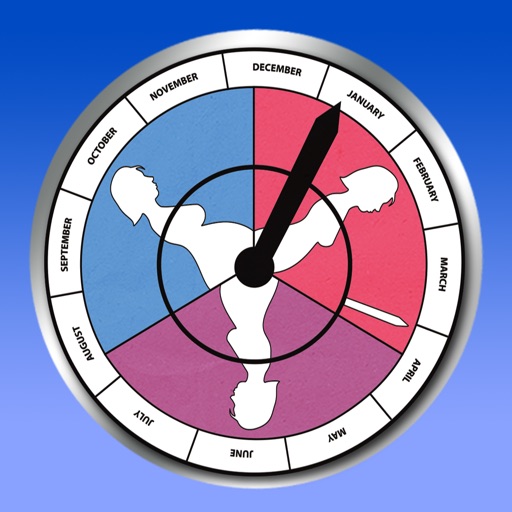 Perfect OB Wheel4.9 in store · rating aligns · 3,555 ratings74our scoreA gestational wheel for clinicians used by nurses and doctors many times a day, valued for speed and the saved patient list. It breaks on date entry, the field jumps ahead and changes the number you typed, and updates make it crash or vanish from the phone. Some resent paying for basics that are free on websites.
Fast dating from last menstrual period, due date or gestational age, saved alphabetical patient list, highlighted current date, everything in one place for the clinic
Input field jumps ahead and changes the date, cannot set cycle length other than 28 days, crashes and disappears after updates, no postnatal day count, easy to mix up LMP and EDD fields
Nurses, OB providers and doctors who need to date many patients quickly
 BabyCenter Pregnancy Tracker4.9 in store · rating aligns · 292,402 ratings72our scorePeople value the detailed week by week baby growth, the sense of support and connecting with other moms. It stumbles on intrusive full screen ads that pop up right as you write a post, and on the hard switch to newborn mode exactly at 40 weeks even though births are often later. Emails from a partner company you cannot unsubscribe from also grate.
Detailed week by week baby growth, feeling supported and not crazy, chatting with other moms, baby name browsing, daily notes on the process
Full screen ads over community replies, hard switch to newborn mode at 40 weeks with no rollback, partner emails with no working unsubscribe, no dark mode, occasional factual errors
Moms who want deep content and community and can tolerate the ads
 Pregnancy Tracker | Preglife4.9 in store · rating aligns · 1,686 ratings72our scoreAn informative pregnancy tracker with Swedish roots, praised for no ads, a post-birth parent mode, partner sharing and less common topics like pelvic floor exercises and your right to decline tests. Some users are annoyed by nagging reminders about alcohol, smoking and weight and a prescriptive tone about diet. Factual slips: the week counter pushes a week ahead, no twin support, occasional forced logouts, and a midwifery student caught a wrong claim about the heartbeat.
No ads and free, switches to parent mode after birth, partner sharing, videos and visualizations, rare topics like pelvic floor and the right to decline tests, baby size as fruit
Week counter runs a week ahead, no twin support, occasional forced logout, prescriptive tone about diet and weight, nagging alcohol and smoking reminders, spelling errors and a debatable fact
Expecting moms who want a free ad-free tracker with partner sharing and a post-birth parent mode
Next: the review findings
You already see the market, the audience and the honest rating. A free sign-in opens the first finding: what people value, what drives them away and why, with quotes.
Free, by email or Telegram