Stock investing
Everyone breaks in the same place: when money is on the line.
The niche splits into four types of demand. Beginners get sold simplicity (, ), but the simplicity ends at the decisive moment: the order to exit a position hangs, and the fill price drifts away from the customer's favor. Serious brokers get paid for depth (Fidelity, ), but the mobile app lies about cash and freezes. Robo-advisors are trusted with "do it for me" (Betterment, ), and the trust collapses at withdrawal: money takes months to arrive, the account suddenly lands under review.
The mechanism is one and the same. The app gets opened at an acute moment: a trade, a withdrawal, a market drop. That's when it has to be fast, honest with the numbers, and clear. And that is exactly where the leaders sag.
Category pulse
8 needs · 29,265 reviews of 73 apps
Market overview
The tone is set by the free giants and Fidelity. They made trading itself free and shifted the value onto data, automation, and education.
- Size
- 14,308,431ratings across 73 apps · 28,130 reviews read
- Concentration
- 64%of all ratings held by the top three
- Downloads
- 104 M+installs across the top 11 on Google Play, led by TradingView: Track All Markets
- What people pay
- $100$10$5$500prices cited in real reviews
- Leaders
- Revenue estimate
- What the niche's top apps make a year. The number opens together with the ideas. Unlock
- Trust
- 48 of 73apps where the storefront star diverges from review text; this is a review signal, not proof of manipulation. 1 score above 80
- Discoverability
- 61 of 100a new app's chance to break in: the top three hold 64% of ratings, 18% of the sample has a large star mismatch, 3 score above 80Computed from leader concentration, gamed share, count of strong apps and demand size. Rough, order of magnitude.
- Money
- Who pays in this niche, for what, and why most players lose money. It opens together with the ideas. Unlock
The gamified brokers (, ) win on easy onboarding and education. They sag on reliability: freezing right after a purchase, crashing on exit, murky fill prices, accounts that can get restricted. The classic brokers (Fidelity, Schwab, ) win on depth and coverage. They sag on the freshness and stability of the mobile app: cash and positions show wrong, the app hangs and crashes, the interface is slow and dated. Robo-advisors and round-ups (Betterment, , M1) win on "do it for me". They sag at getting money out: withdrawals take months, accounts get put under review. Trackers and AI signals (, ) win on analytics. They sag on data accuracy (numbers are wrong or stale) and on trust in crowd signals.
Main players
App Store · United States · Aug 30, 2026
stock portfolio · 5 / 19

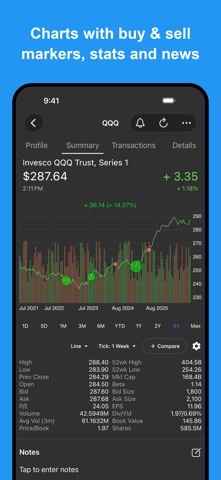


Keywords in this sample
- stock portfolio #1
- stock tracker #5


Keywords in this sample
- stock portfolio #2
- stock tracker #3
- stock market #3
- stock screener #4

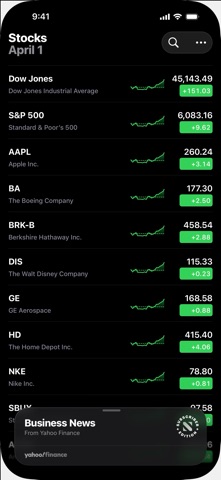


Keywords in this sample
- stock portfolio #3
- stock tracker #2
- stock market #1
- investing app #6
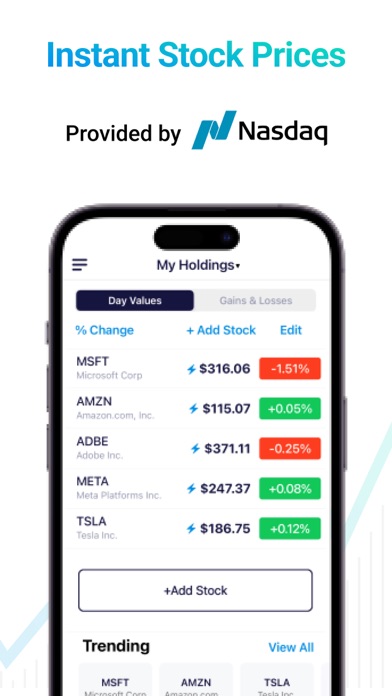



Keywords in this sample
- stock portfolio #4
- stock tracker #7


Keywords in this sample
- stock portfolio #5




Data & sources
App Store search: Aug 30, 2026 · 5 queries · 37 apps. An app’s keywords show only positions found in this sample.
Positions follow Apple’s Search API response and may differ from results on a device. Rating counts are not installs or market share.
Screenshots come from the US App Store. Data is a saved snapshot, not a live feed.
Search data source ↗Audience
"Stock investing" is not one customer. Inside are different people with different jobs, and they pay very differently. First you choose who you build for.
Where the money is
Where users come from
Channels visible right in the reviews: people say themselves how they found the app and why they installed it. This is the niche's distribution.
Bloggers and ads: youtube, tiktok, tv6
Brokers flood YouTube and television with ads featuring bonus rates and famous faces, finfluencers hand out promo codes, teenagers learn about the apps from TikTok. People come for the promised rate or a blogger's tip and get angry when the rate melts once they're in.
I knew about this app through TikTok and thought I could handle something's through some help and guidance with this app
When I 1st created my account I was able to invest at the 4.2% apr that was advertised on tv. After the 1st month that went down to 3.8%... I closed my account. I still see tv ads for 4.2%.
A bonus for a friend: referrals4
The niche is trained to pay for referrals: deposit bonuses and invite-a-friend buttons are built in almost everywhere, and users genuinely come for them. But the bonus has to actually pay out, someone cheated on a referral takes revenge in the reviews.
I recently downloaded this app because a friend told me they offer a $3,500 deposit bonus. However, after downloading it, I didn't see any sign of that bonus or any promotion.
The idea of earn money refering friends is a really good idea
The employer: 401k and company stock3
A broker's app often isn't a choice: the employer keeps the retirement plan there or grants employees stock. The audience is captive and picky, and for a third-party product the way in is the job of pulling all accounts into one place.
I'm disappointed that my employer sponsored 401k doesn't have the ability to track growth overtime, see what stocks I'm invested in, etc. The only thing I can see see in the app is my total amount invested.
Need to do a better job of disclosing employer stock plan fees
Word of mouth in the family2
The investing family member pulls in the relatives: opens custodial accounts for the kids, an adult daughter signs up after her parent. A product that makes a first account for your own people easy gets these installs without marketing.
Now most of my family is using it as well!! My 21 year old daughter recently joined and she is learning so much more than I could teach her!!
I appreciate having control, learning here from stash as I research which investments are a right fit for my needs. My family uses the "custodial" accounts as our children learn alongside us.
Review-based rating
The same sample of 73 apps in two scoring systems. Switch to see how the storefront star aligns with what people write in reviews.
 Stock Analysis: Stocks & Funds4.9 in store · rating aligns · 4,989 ratings84our scoreA clean, easy tool for analyzing stocks and funds with a large volume of data and a surprisingly generous free tier. People praise the compare feature, dividend info and cross-device syncing. The only downsides are occasional crashes after updates and requests to add brokerage linking.
Fast access to data on almost any stock or fund, and a handy compare feature. A generous free tier, cross-device syncing, and pre- and post-market portfolio tracking. Clean minimalist design and a fair price.
No brokerage link, so shares and average prices have to be entered by hand. Some updates cause crashes. People want stock and fund heat maps.
Investors who want a reliable source of stock and fund data and analysis without extra bells and whistles.
 NetDania Stock & Forex Trader4.6 in store · rating aligns · 15,100 ratings74our scoreA long-standing live quote tracker for currencies and stocks that people value for accurate data. The main problem is that after a change of ownership the app got buried in intrusive and sometimes vulgar ads. The tool is still useful, but the ads spoil it.
Accurate live quotes for currencies and spot markets, plenty of instruments, and a recognizable solid look in the TradingView vein. Fast and reliable for daily rate tracking.
After the ownership change ads flooded in, some of them vulgar and out of place for a finance app. There are crashes on certain features and iOS versions, and quotes sometimes lag.
People who track currencies and spot markets daily and want accurate live rates. Not for those who are enraged by ads and unwilling to pay to remove them.
 Wealthfront: Save and Invest4.8 in store · rating aligns · 17,416 ratings72our scoreA solid automated index investor and account aggregator that recently broke its headline feature. The switch to Plaid wrecked external account linking, so the net worth tracker stopped updating on time. The investing core stays reliable, but the wrapper now annoys long-time users.
Hands-off automated index investing you never have to babysit. Clean interface, performance history right in the app, the feeling that your money grows on its own.
After the Plaid switch external accounts update days late or freeze at zero, forcing you to reconnect banks several times a week. The ability to build sector portfolios is gone.
People who want to drop money into index funds and forget it while seeing every account in one place. Not for those who need to hand-pick individual stocks.
 tastytrade: Invest & Trade4.8 in store · rating aligns · 13,206 ratings66our scoreOne of the best brokers for options trading on execution and commissions, held back by raw, buggy apps. Every update spawns new problems: zeroed columns, stuck quotes, vanished watchlists. Professionals tolerate it for the execution quality.
Top-tier options trade execution, competitive commissions, and a clean mobile format. For options, many keep it as their main platform.
It keeps breaking after updates: zeros in positions, duplicated trade notifications, stuck quotes, lost watchlists. The iPad app is missing some indicators, and it crashes in active mode.
Options traders who care most about fast execution and low commissions. Not for those who need stability and deep charting on a tablet.
 Schwab Mobile4.8 in store · rating aligns · 1,186,101 ratings63our scoreSchwab Mobile reads easily and suits beginners, and people like the fee-free setup and card rebates. But the app fails at trade moments: it freezes, drops the session before an order, and sometimes shows wild balance errors. For active trading many still move to desktop or thinkorswim.
Simple clear interface, good for beginners, no fees and card rebates, feels safe
Freezes and session drops before an order, gross balance errors, stripped down versus the site, weak charts for trading, transfers cancelled without explanation
Schwab clients for calm portfolio viewing and simple trades, not active trading
 Robinhood: Trade Anything4.3 in store · rating aligns · 4,781,611 ratings62our scoreRobinhood is still the simplest way into the market, but order execution fails at the worst moment: the buy button locks during trading halts, and fill prices draw complaints about a hidden spread. People report frozen money after big gains and a painful support line. Still, many praise the ROTH IRA match and the card.
Simple pleasant interface, fractional shares, ROTH IRA match, easy start for beginners, learning
Account locked after large profit, shady fill prices and spread, buy button disabled during halts, weak support, gambling-style predictions in the feed
Beginners and anyone wanting a simple mobile entry into stocks and options without extra setup
 IBKR Mobile - Invest Worldwide4.5 in store · rating aligns · 11,195 ratings62our scoreA serious broker with worldwide market access, low fees, and powerful tools, wrapped in an awkward app. The interface is confusing, state resets when you switch away, and ACH transfers land slower than rivals. Professionals stay for the global reach and pricing.
Access to global markets, low commissions, and a rich set of analytical and algorithmic tools. Reliable operation and strong security once you learn it.
The interface is cluttered and clumsy, and everything reloads when you return to the app. ACH transfers post slowly, lifting the PDT restriction drags on, and support is sluggish.
Experienced investors who need global market access and low fees and can tolerate a bulky interface. Not for beginners after simplicity and instant transfers.
 Zacks Mobile App4.2 in store · rating aligns · 3,993 ratings62our scoreBehind the app is a respected source of stock research and ratings, and people trust the content. But the app itself lags well behind the website: it glitches, hangs on the loading screen, has no back button, and on iPad only supports portrait mode. There's a worrying complaint about a personal-data breach.
Valuable research, ratings and stock lists from a well-known source. Helps make buy decisions and plan returns in retirement accounts. Easy access to rankings and data.
The app glitches, hangs on the loading screen and crashes at startup on some devices. No back button, portrait-only on iPad, and notifications won't open. There's a complaint about a personal-data breach and trouble cancelling the trial.
Zacks subscribers and people who value its research and can tolerate the app's awkward interface.
Next: the review findings
You already see the market, the audience and the honest rating. A free sign-in opens the first finding: what people value, what drives them away and why, with quotes.
Free, by email or Telegram