Authors describe exercises that did not match the limitations they had stated. Saved exclusions and the ability to follow a prescribed plan are needed; the app should not confirm the safety of a load on its own.
Which apps people use
These apps are mentioned in the breakdown of this job. Open each one to compare strengths and limits. The order of the list is not a ranking of fitness.
Rank 50. Review score: 48 out of 100. App Store rating: 4.7★ · 8,399 ratings
48of 100
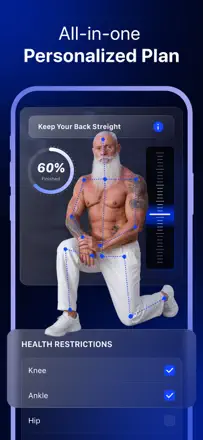
Well-chosen exercises for older adults with live instructors and video, but intensity is too low even for the target audience, instructions are not synchronized with the trainer's movements, and the gender filter for coaches does not work as advertised.
Praised: Real live trainers instead of animated characters, at a pace that is comfortable for older adults.
Complaints: Voice instructions lag behind on-screen movements, which is confusing during more complex exercises.
Best for: Adults 60 and older who prioritize movement safety and a simple interface.
Rank 52. Review score: 45 out of 100. App Store rating: 4.6★ · 134,315 ratings
45of 100
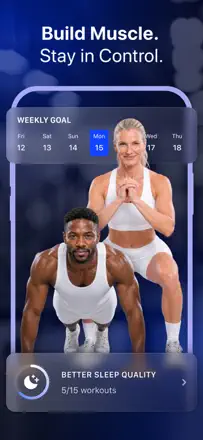
Muscle Booster covers a wide range of formats from strength to tai chi and chair workouts for older and low-mobility users. The home and gym sections were built by different teams without a shared standard: audio cues and weight recommendations are inconsistent between the two.
Praised: Chair workouts and tai chi for older users with limited mobility actually deliver results.
Complaints: The home and gym sections operate by different rules: one has audio cues and the other has weight recommendations, and they do not overlap.
Best for: Older adults and people with limited mobility who need adapted workout formats.
Rank 55. Review score: 44 out of 100. App Store rating: 4.8★ · 142,801 ratings
44of 100
An app for the home rehab program prescribed by a physical therapist. The core problem is not the content but the mechanics: exercise timers consistently do not match what the specialist prescribed, and there is no simple way to log completion outside the app.
Praised: Video demonstrations help confirm correct technique when performing rehab exercises at home.
Complaints: Exercise timers are not synchronized with therapist prescriptions: a 30-second hold becomes a 5-second timer on screen.
Best for: Patients on a home rehabilitation program prescribed by a physical therapist.
Rank 38. Review score: 55 out of 100. App Store rating: 4.7★ · 8,789 ratings
55of 100
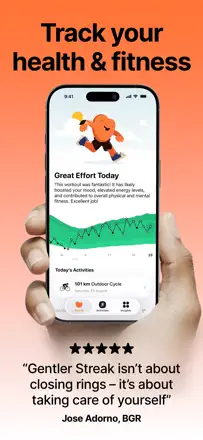
The only app in its niche that tracks load and recommends recovery instead of pushing for records. The load algorithm can be overly conservative: it sometimes demands three rest days after a 30-minute walk, which erodes trust in its recommendations.
Praised: The philosophy of moving sustainably without burning out genuinely helps people build a lasting habit.
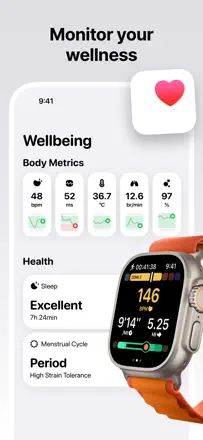
Complaints: The load recommendation algorithm does not work correctly without Apple Watch and overestimates fatigue.
Best for: Anyone who has burned out on fitness streaks and wants a gentle tracker without pressure to hit records.
Rank 24. Review score: 58 out of 100. App Store rating: 4.9★ · 6,782 ratings
58of 100
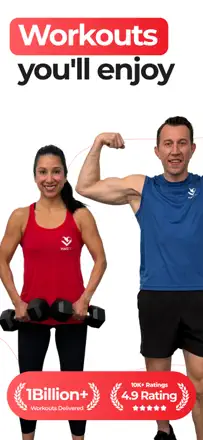
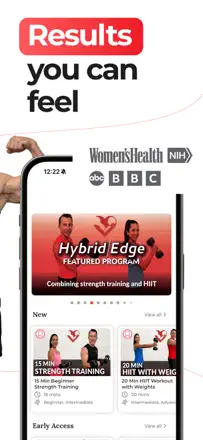
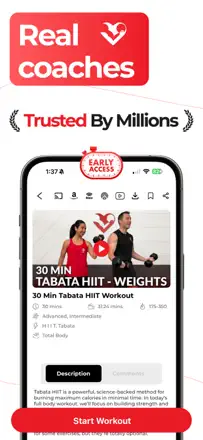
Strong content from a real coaching duo with an extensive video library and no-equipment options, but the app is technically rough: freezes, TV streaming issues, and inaccurate timers frustrate regular users.
Praised: Live workouts from Coach Kozak and Claudia with form cues and modifications for different fitness levels.
Complaints: Search and filtering are inconsistent, the no-equipment mode is not respected, and strength programs for older adults are nearly absent.
Best for: Home workouts without a gym or personal trainer.