They need to try speaking in the situation the language is being learned for, and see where the difficulties are. An exercise on single words and a live conversation test different skills.
Which apps people use
These apps are mentioned in the breakdown of this job. Open each one to compare strengths and limits. The order of the list is not a ranking of fitness.
Rank 6. Review score: 78 out of 100. App Store rating: 4.7★ · 27,768 ratings
78of 100
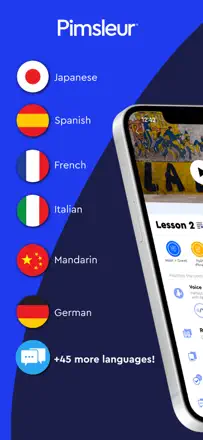
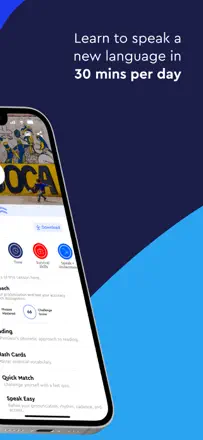
An audio course that teaches speaking and listening comprehension through active recall from the very first lesson. Spaced repetition is built into the audio: the app asks you to reproduce a phrase at increasing intervals. Users with five languages under their belt call Pimsleur the best method for reaching conversational fluency. Grammar is not explained explicitly but absorbed through context.
Praised: You can learn hands-free with no screen: lessons run 30 minutes and only require earphones. Several users report having real conversations with native speakers after finishing the first level, a concrete result rather than just a feeling of progress.
Complaints: No written component and no grammar explanations. For learners who study through reading and systematic analysis the method works poorly. Difficulty cannot be adjusted: the app starts from zero regardless of your existing knowledge.
Best for: Those who want to speak and understand spoken language, learn on the go, and are comfortable with an audio-only format without visual support.
Rank 4. Review score: 85 out of 100. App Store rating: 4.8★ · 9,350 ratings
85of 100
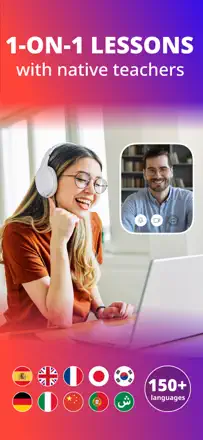
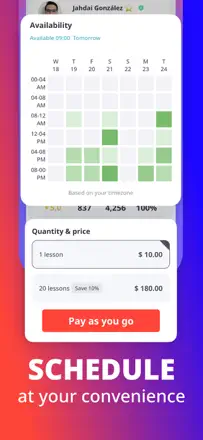
A marketplace of live teachers and language partners, and the only reliable way to reach real speaking practice. Huge choice of languages and formats, with native speakers available for almost any language in the world. Quality depends on the teacher you pick, but the search tools and reviews help.
Praised: Live sessions with native speakers matched to your level, the choice between a structured lesson or conversation practice, and a wide range of languages including rare ones.
Complaints: The app is just a storefront: it does not teach on its own. You have to find a good teacher yourself. Without independent practice between sessions, progress is slow.
Best for: Those who want real speaking practice with a live person and are ready to commit to regular sessions.
Rank 20. Review score: 70 out of 100. App Store rating: 4.7★ · 98,982 ratings
70of 100
One of the few apps that genuinely teaches speaking and explains grammar: structured lessons, videos with native speakers for Spanish, and community checking of written answers. Users compare it to a classroom course.
Praised: Grammar rules explained in the context of phrases. Lessons build from simple to complex without skipping ahead. Written exercises checked by real native speakers. Video recordings with native speakers for Spanish provide authentic speech.
Complaints: Voice recognition is unstable and sometimes marks a wrong answer as correct. The interface responds with a lag. Not all languages are developed equally well: Japanese is not as thorough as Spanish.
Best for: Adults who want to study a language systematically and get to conversational speech. Especially for those who care about grammar.
Rank 28. Review score: 65 out of 100. App Store rating: 4.7★ · 23,331 ratings
65of 100
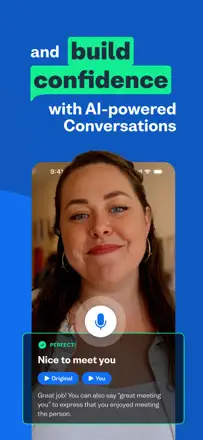
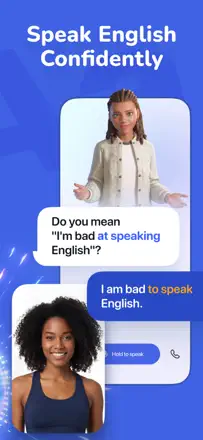
An AI tutor for spoken Spanish and English practice through role-play scenarios: a cafe, a doctor's appointment, work. The app hears your speech, responds, and flags conjugation and pronunciation errors in real time. Users coming from Duolingo notice the difference: there they read and clicked, here they speak. Limitation: only two languages, no sequential grammar course.
Praised: Conversational scenarios close to real situations: the AI holds a full dialogue rather than just waiting for a correct answer. One user, after four years of Duolingo, started speaking Spanish for the first time here.
Complaints: Does not build a grammar foundation: no structural explanations, only in-the-moment corrections. Beginners without a base will struggle since the dialogue pace is too fast without prior pattern practice.
Best for: Those who know Spanish or English at a beginner level and want to move from reading and tests to real speaking.
Rank 38. Review score: 60 out of 100. App Store rating: 4.8★ · 49,281 ratings
60of 100
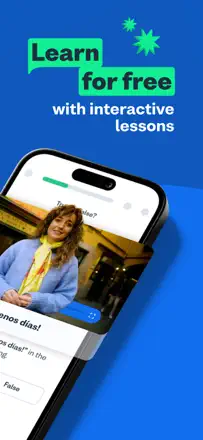
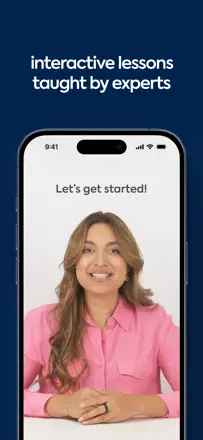
The app builds each lesson around video from a native speaker and AI pronunciation checking, and users who spent years on Duolingo without speaking report real progress here, though the language selection is small.
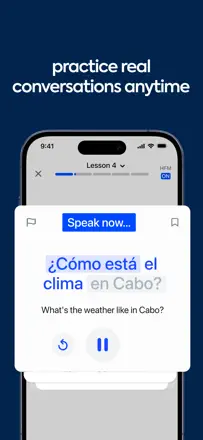
Praised: Each lesson is built around a native-speaker video, phrase repetition, and AI pronunciation feedback. A hands-free mode lets you learn during a commute. Syllable-by-syllable breakdown genuinely helps place sounds.
Complaints: Only five or six languages are available. Speech recognition misses certain consonants. The Japanese tutor in question-and-answer mode systematically rejects correct answers.
Best for: Intermediate learners of Spanish, Korean, or Italian who want to move from reading to speaking. Not for complete beginners.