After an identification the author may still have questions about the properties of the plant. Information about toxicity and edibility has to be separated from a guess at the species from a photograph and backed by a verifiable source.
Which apps people use
These apps are mentioned in the breakdown of this job. Open each one to compare strengths and limits. The order of the list is not a ranking of fitness.
Rank 4. Review score: 65 out of 100. App Store rating: 4.6★ · 7,005 ratings
65of 100
The strongest app in this set for species accuracy in the field, with organ selection and geotagging. The core product gap: no care advice, watering, or diagnosis, and some users get IP-blocked.
Praised: Accurately identifies species from a leaf, flower, or fruit with high precision, including rare plants.
Complaints: Zero care information: after identification the user has to go elsewhere for any advice.
Best for: Naturalist, botanist, or gardener who needs precise species identification
Rank 11. Review score: 55 out of 100. App Store rating: 4.8★ · 30,827 ratings
55of 100
A free wildlife identifier with a solid database and an educational approach, but after the latest update the camera stops focusing up close and 50% of attempts fall into the "dicots" catch-all. Not designed for houseplant care.
Praised: Gamification through challenges and badges draws both kids and adults into learning about nature.
Complaints: Gives no care advice whatsoever, only species identification with no watering, disease, or lighting guidance.
Rank 21. Review score: 46 out of 100. App Store rating: 4.6★ · 68,050 ratings
46of 100
One of the oldest identifiers with a large database, working well on trees and wildflowers, but it consistently flags three-leaf plants as poison ivy and offers almost no care tools. Disease diagnosis is generic and unreliable.
Praised: Quickly identifies wild species from a photo with no preparation needed, large flora database across many regions.
Complaints: No dedicated care or watering module, and identification in ambiguous cases is unreliable with no alternative suggestions.
Best for: Naturalists and hikers who need to quickly identify a wild plant on the trail
Rank 8. Review score: 58 out of 100. App Store rating: 4.8★ · 1,088,124 ratings
58of 100
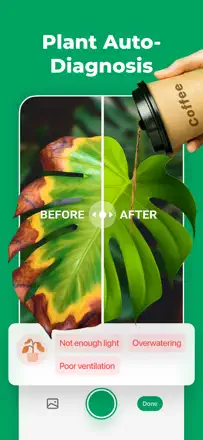
The market leader in plant identification with genuinely decent accuracy on common species, but unstable on cultivars and hybrids. The key weakness is that disease diagnosis sits behind a paywall, making the free tool nearly useless for treating sick plants.
Praised: Accurately recognizes common flowers and trees across different climate zones, works in the field without fuss.
Complaints: The same photo of the same plant returns different species on repeated attempts, and accuracy on cultivars is unreliable.
Best for: Casual gardeners who need quick identification without in-depth diagnosis
Rank 34. Review score: 31 out of 100. App Store rating: 4.4★ · 3,599 ratings
31of 100
Identification is unreliable for common cultivated plants, and diagnosis gives generic advice instead of concrete steps. Users who need help with a sick plant leave disappointed.
Praised: Works better for wild plants and garden perennials than for vegetable crops.
Complaints: Disease diagnosis is limited to general recommendations with no concrete actions.
Best for: People who enjoy walking and identifying wild plants