Figure out whether the sky will be clear tonight at a specific spot, so they can decide whether to set up the telescope and camera or not waste the night
The decision to head out depends on the forecast for the place and time of the observation. A person needs to see clearly how current the data is and to be able to compare the forecast with the conditions on the spot.
Which apps people use
These apps are mentioned in the breakdown of this job. Open each one to compare strengths and limits. The order of the list is not a ranking of fitness.
Rank 3. Review score: 74 out of 100. App Store rating: 4.8★ · 1,532 ratings
74of 100
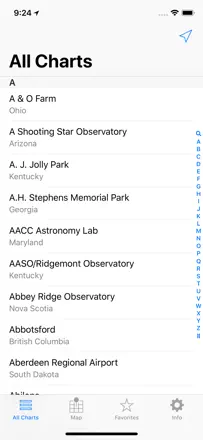
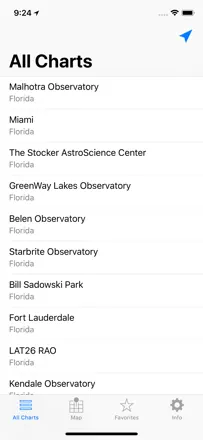
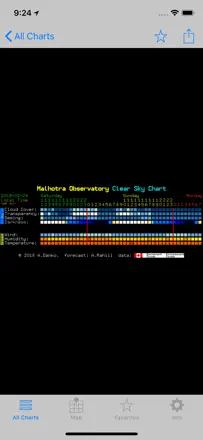
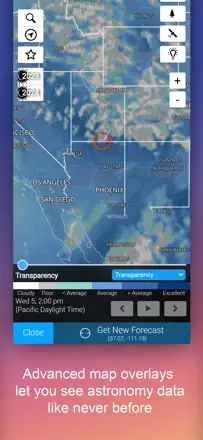
Astrophotographers have trusted it for years as the most accurate cloud forecast for observing, some for over 20 years. They value the quick jump to the local chart and its reliability. It breaks on tiny non-zoomable text on iPad, no search across the site list, no way to launch straight into a favorite location, and colors that make no sense to beginners without a legend.
Praised: Most accurate cloud forecast for observing, quick access to the local chart, reliability and daily updates, proven over years
Complaints: Tiny non-zoomable text on iPad, no search over the site list, cannot launch straight into a favorite location, no legend so colors confuse beginners
Best for: Astrophotographers and observers who need an accurate clear-sky forecast before heading out
Rank 5. Review score: 72 out of 100. App Store rating: 4.8★ · 438 ratings
72of 100
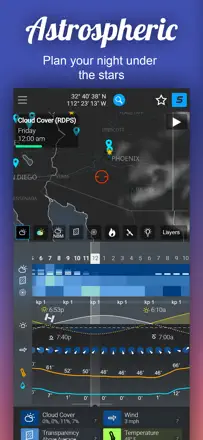
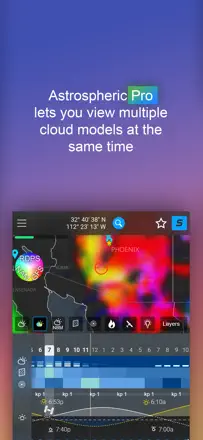
Astrophotographers love it for accurate cloud and seeing forecasts: it saves wasted evenings and helps decide whether to shoot in Ha or Oiii by conditions. It stumbles on local accuracy and stability: temperature runs 8-12 degrees off for some, cloud forecasts occasionally miss, and the free version is less accurate and nudges toward a subscription. Plus the network sometimes breaks and the main page reloads endlessly.
Praised: Accurate cloud and seeing forecasts, planning imaging sessions without wasted setups, everything needed in one place, choosing filter by seeing, handier than the old cleardarksky
Complaints: Temperature off by 8-12 degrees in some regions, cloud forecast occasionally inaccurate, free version noticeably less accurate, network errors and endless main-page reloading, dark hard-to-read interface, no widgets
Best for: Astrophotographers and observers who plan trips by weather and cloud cover and will pay for accuracy
Rank 40. Review score: 42 out of 100. App Store rating: 4.5★ · 766 ratings
42of 100
Valued for a fast, visual week-ahead weather forecast for observing: in a couple of seconds you know whether it's worth hauling the telescope out. But the app has gone years without updates and is riddled with errors: 'forecast unavailable' pops on every launch, saved sites get forgotten, and it can't find your location even at home. For a paid five dollars people call it abandoned.
Praised: Fast visual week-ahead forecast for observing, pleasant interface for a quick glance, cloud-cover accuracy when it works, planning trips
Complaints: 'forecast unavailable' error on every launch, forgets saved sites, fails to find location, no updates in 3-6 years, feels abandoned for a paid app
Best for: Amateur astronomers who want a quick week-ahead weather glance and can tolerate constant errors
Rank 18. Review score: 58 out of 100. App Store rating: 4.4★ · 2,924 ratings
58of 100
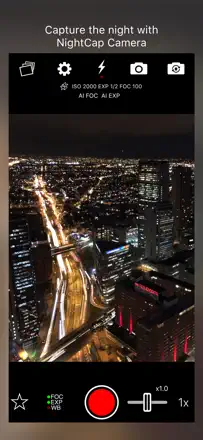
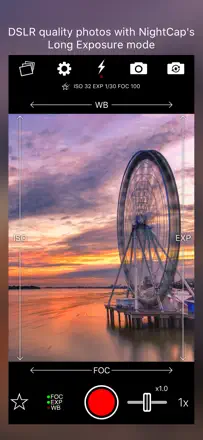
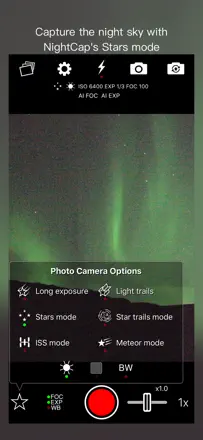
This is a deep manual camera-control tool for shooting stars, the ISS, star trails and timelapses, and people who master the tutorials genuinely like it, with no equivalent on other platforms. But it has gone long without updates and lags and freezes badly on newer iPhone 16 and 17 Pro, and the Moon comes out grainy and blurry even following its own guide. Some got better aurora shots on the plain camera app.
Praised: Deep manual camera control like real photography, ISS, star-trail and timelapse modes, a cheap way into astrophotography without expensive gear, no equivalent on other platforms
Complaints: Lags and freezes badly on iPhone 16 and 17 Pro, long without updates, the Moon comes out grainy and blurry even by the tutorial, no Bluetooth shutter, steep learning curve
Best for: A beginning astrophotographer willing to work through the tutorials for night shots without expensive gear
Rank 35. Review score: 47 out of 100. App Store rating: 4.6★ · 14,641 ratings
47of 100
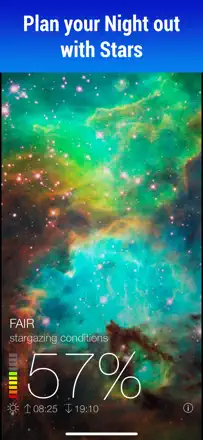
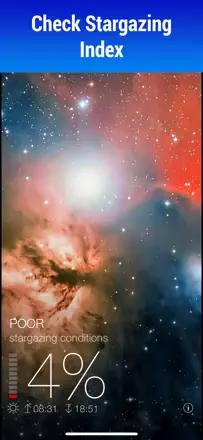
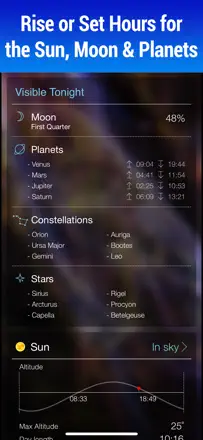
The app shows observing conditions and sky events for your location, and when you're at home it works great and is clear. But the main flaw is that searching other locations barely works, and that's exactly what you need to plan a trip to dark skies away from the city. On top of that it hasn't been updated in a while and the clear-sky percentage sometimes doesn't match reality.
Praised: Local and accurate observing conditions, interesting upcoming sky events, clear and intuitive view, helps beginners with a telescope
Complaints: Searching other locations barely works by address or zip, only major cities, can't save your own spot, no updates in a long time, clear-sky percentage sometimes disagrees with the weather, dull grey widget look
Best for: People who mostly observe from home and want the conditions and events for their own location
Rank 6. Review score: 68 out of 100. App Store rating: 4.8★ · 1,079 ratings
68of 100
Experienced hobbyists and astrophotographers keep it as their main planetarium program for planning and observing, valuing the depth and quality of information and the point-device-at-sky tracking. It breaks because the shift to a subscription pulled features long-time buyers already paid for, updates wiped telescope settings and connection points, and one update broke the point-at-sky tracking.
Praised: Main planetarium program for planning astrophotography, depth and quality of information, point-device-at-sky tracking, regular updates
Complaints: The shift to subscription pulled already-paid features, updates wiped telescope settings and connection points, broke the point-at-sky tracking, confusing interface and lacking instructions
Best for: Experienced amateur astronomers and astrophotographers who plan observations and shoot with a telescope