These apps are mentioned in the breakdown of this job. Open each one to compare strengths and limits. The order of the list is not a ranking of fitness.
Rank 9. Review score: 60 out of 100. App Store rating: 4.7★ · 4,131 ratings
60of 100
A question bank for medical exam prep (USMLE, NCLEX, LPN). Explanation quality and question volume are high, with flashcards available as a supplement to the Q-bank. The mobile app is unreliable: systematic authentication problems (Face ID, session dropouts), crashes on iPad, and progress loss on connection drops. The web version is more stable.
Praised: Detailed explanations for every question that walk through clinical reasoning not just the right answer.
Complaints: The mobile app doesn't work offline, which is critical for clinicians studying between shifts.
Best for: Medical and nursing students preparing for USMLE or NCLEX who study primarily on a computer.
Rank 4. Review score: 68 out of 100. App Store rating: 4.9★ · 21,102 ratings
68of 100
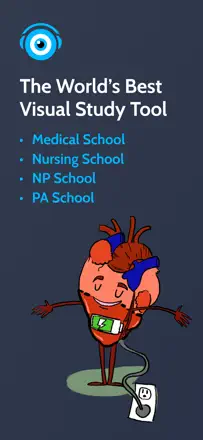
Picmonic is a mnemonic learning tool for medical students short video stories with characters that encode medical facts. Not flashcards in the classic sense, but closer to them than a dictionary. The content for medicine (NCLEX, pharmacology, pathophysiology) is specialized and deep.
Praised: Narrative approach: each disease or drug is a short story with memorable characters. Users report the information sticks far better than reading from a textbook.
Complaints: Some practice questions contain factual errors (e.g., confusing 'associated with' and 'treated by'). Navigating the catalog for NP programs is confusing.
Best for: Nursing and medical students preparing for NCLEX or Step exams. Not applicable to other disciplines.
Rank 19. Review score: 44 out of 100. App Store rating: 4.8★ · 2,885 ratings
44of 100
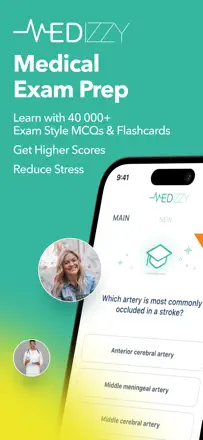
MEDizzy Medical Exam Prep is a social platform with medical MCQ questions, flashcards, and clinical cases. Flashcards are included but there's no SRS. The main strength is a large bank of clinical questions with visual cases. The weakness is that typos and grammar errors in the questions undermine trust in medical content. No explanations are given for why the correct answer is correct. Restoring a lifetime subscription without the original Apple ID is impossible.
Praised: Clinical cases with visual aids. Broad specialty coverage. The feed-style format makes it easy to scroll through.
Complaints: No explanations for correct answers. Typos and errors in medical terminology. App crashes when switching to the background. No volume control during a session.
Best for: Medical students and paramedics preparing for USMLE, NREMT, and similar exams through question practice.
Rank 2. Review score: 72 out of 100. App Store rating: 4.0★ · 2,293 ratings
72of 100
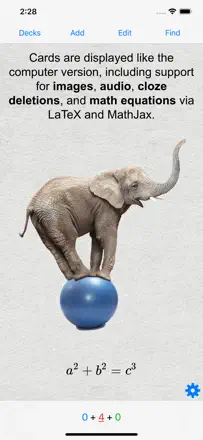
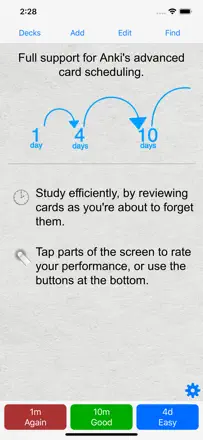
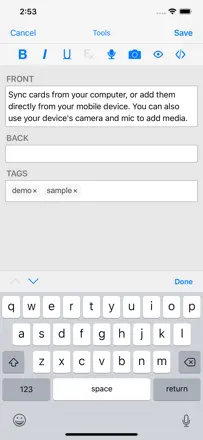
AnkiMobile Flashcards is the mobile port of the legendary Anki SRS engine. The spaced-repetition algorithm is the best in the category: configurable retention, FSRS, proven over decades. It supports media cards, import/export via AnkiWeb, and thousands of community decks. The one significant weakness is the interface it feels archaic, doesn't follow iOS conventions, and has a steep learning curve. Complex card editing is desktop-only. One-time purchase of $25.
Praised: FSRS with configurable retention delivers a science-backed review schedule. Sync through AnkiWeb. Thousands of community decks for languages, medicine, law, and more.
Complaints: The interface doesn't follow iOS patterns and still feels like a web wrapper. Complex card editing is only available on desktop. There's no obvious button to study an entire deck.
Best for: Med students, linguists, law students, and anyone serious about long-term retention who is willing to spend an hour on setup to get the best algorithm available.
Rank 1. Review score: 72 out of 100. App Store rating: 4.7★ · 19,909 ratings
72of 100
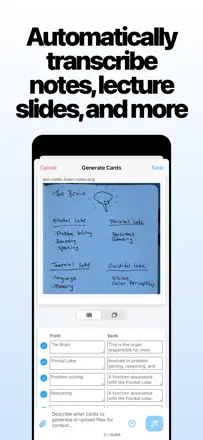
AlgoApp (formerly Flashcard Hero) is one of the best pure SRS tools on iOS. It supports FSRS one of the most accurate spaced-repetition algorithms available along with AI card generation and cross-platform sync. The technical issues are real, but longtime users give it high marks for good reason.
Praised: The FSRS algorithm adapts the review schedule to your actual responses more precisely than Anki's classic SM-2. An AI assistant generates cards right inside the app. There's a huge library of pre-made decks to download.
Complaints: Sync between devices is unreliable. CSV import doesn't auto-convert phonetic transcriptions. Cards inside downloaded community decks can't be edited.
Best for: Serious language learners and exam preppers who want a top-tier repetition algorithm and the ability to build their own material.