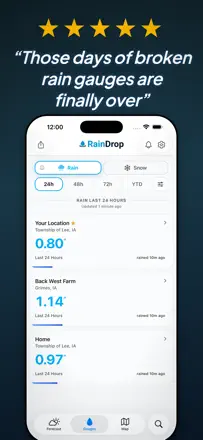
A RainDrop author compares the data with his rain gauge. The summary benefits from a source and a period, so that a model estimate is not mixed with a local measurement.
Which apps people use
These apps are mentioned in the breakdown of this job. Open each one to compare strengths and limits. The order of the list is not a ranking of fitness.
Rank 17. Review score: 58 out of 100. App Store rating: 4.6★ · 10,936 ratings
58of 100
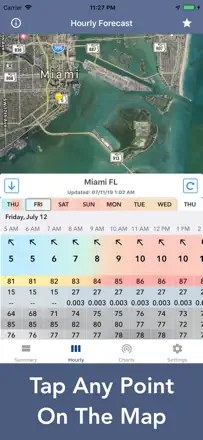
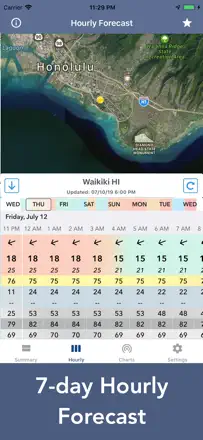
The app is valued for its graphical precipitation accuracy and an honest 14-day horizon without extra noise. The hourly forecast periodically breaks and shows only one time slot, making it a useless widget until the next refresh.
Praised: Accurate precipitation figures without panic or unnecessary dramatization.
Complaints: The hourly forecast sometimes collapses to a single 1 a.m. row and stops updating without a reinstall.
Best for: Those planning trips, outdoor work, or farming tasks two weeks out
Rank 40. Review score: 44 out of 100. App Store rating: 4.7★ · 19,566 ratings
44of 100
An app with a unique niche for tracking rainfall for farmers and agronomists, and when the data matches a physical rain gauge it is irreplaceable. But systematically underreporting actual precipitation by 30-40% compared to physical measurements is the key accuracy problem.
Praised: Historical precipitation data for a specific map point without needing to go check a physical gauge.
Complaints: Precipitation data regularly underreports physical gauge readings by a third or more.
Best for: Farmers and agronomists monitoring plot moisture
Rank 15. Review score: 58 out of 100. App Store rating: 4.6★ · 27,805 ratings
58of 100
Tomorrow.io outperforms most competitors on hyperlocal precipitation forecasts tied to exact map coordinates, but the 10-day forecast is unstable, sunrise/sunset times show an offset, and push notifications regularly fail to fire.
Praised: Precipitation forecast is tied to precise coordinates rather than the city as a whole, which matters most in areas with complex terrain.
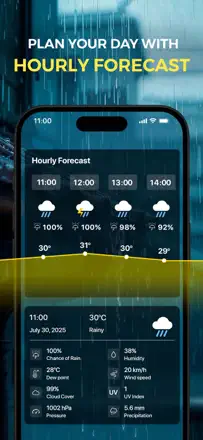
Complaints: The daily and hourly forecasts sometimes contradict each other, which is confusing when planning.
Best for: Those for whom it matters whether rain will fall here in the next hour
Rank 8. Review score: 63 out of 100. App Store rating: 4.6★ · 12,074 ratings
63of 100
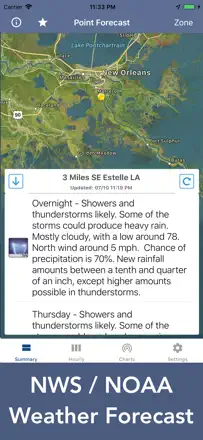
A clean, ad-free interface layered over NWS data, with a forecast discussion forum. Accuracy is good in spring and summer, slightly weaker in winter. The most honest minimalism in the segment.
Praised: The NWS forecaster Forecast Discussion is the most informative text forecast available, something no other app offers.
Complaints: Zone and acronym navigation is opaque for newcomers, and switching regions takes extra steps.
Best for: US users who want raw NWS data without extra layers
Rank 58. Review score: 40 out of 100. App Store rating: 4.6★ · 8,964 ratings
40of 100
Pleasant visuals and hyperlocal forecast for rural areas where the nearest airport station is far away, but accuracy is inconsistent. Radar maps without a legend are nearly useless, and unit settings reset on their own.
Praised: Hyperlocal forecast is useful in remote areas where the nearest weather station is 30 miles away.
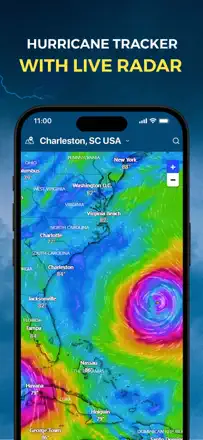
Complaints: The radar has no color legend, so it is impossible to read precipitation intensity from the map.
Best for: Farmers and small-town residents in the US Midwest