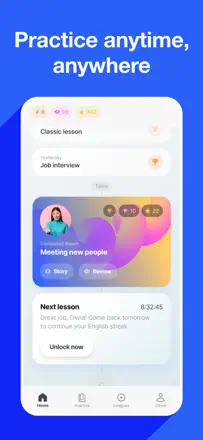
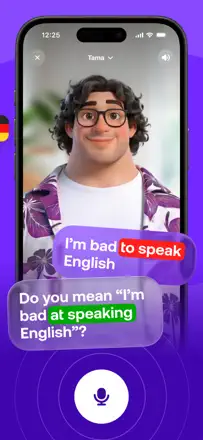
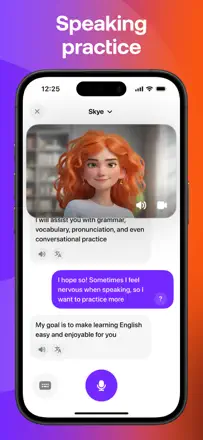
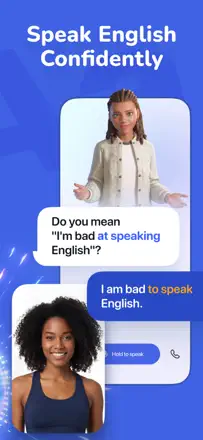
Practice speaking without the fear of making a mistake in front of a live person: get out of the state where the knowledge is there but panic blocks the conversation
The person needs practice where mistakes cost no embarrassment. It is worth checking whether the chosen scene helps them speak for themselves and then carry that experience into the situation they need.
Quelles apps les gens utilisent
Ces apps sont mentionnées dans le décryptage de cette tâche. Ouvre chacune pour comparer les points forts et les limites. L’ordre de la liste n’est pas un classement d’adéquation.
Rang 24. Note des avis : 68 sur 100. Note sur l’App Store : 4,9★ · 36 047 notes
68sur 100
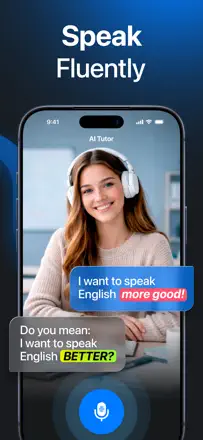
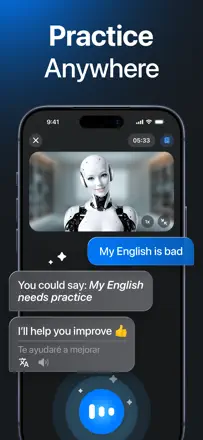
An AI conversation partner for spoken English practice: the app listens, responds in real time, and flags pronunciation and grammar errors. For many users this is their first experience speaking English without fear of judgment, and the psychological barrier genuinely drops. Depth of grammar explanations is limited and the app does not deliver a structured course, but it creates a space for conversational practice.
Points forts : Speaking without fear of making mistakes: the AI is patient, waits for your answer, and does not judge. Immediate pronunciation correction after each response lets you track specific errors in real time while speaking.
Reproches : Does not build a language system: no sequential grammar course, no structural explanations. For a complete beginner the app will be too demanding since it assumes a basic vocabulary is already in place.
Pour qui : Those who understand English but are afraid to speak and want regular conversational practice without a live partner.
Rang 64. Note des avis : 42 sur 100. Note sur l’App Store : 4,8★ · 157 097 notes
42sur 100
The entire format is built around live conversation with an AI tutor, which is valuable for spoken practice. But the tutor mispronounces words in German, mixes registers in Japanese, and does not understand speech in languages with unfamiliar phonetics.
Points forts : Immersive conversational format with real-life scenarios. For B2-level French this is a good space for speaking practice without the stress of a live partner.
Reproches : The AI tutor mispronounces words (German, Japanese), confuses formal and informal registers, and does not recognize speech in languages with non-Latin phonetics. Progress is not saved between sessions for some users.
Pour qui : Intermediate to advanced learners (B1 and above) in French or Spanish who want AI-driven conversational practice and can tolerate inaccuracies.
Rang 28. Note des avis : 65 sur 100. Note sur l’App Store : 4,7★ · 23 331 notes
65sur 100
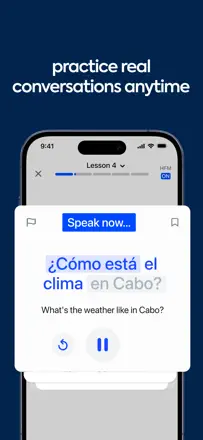
An AI tutor for spoken Spanish and English practice through role-play scenarios: a cafe, a doctor's appointment, work. The app hears your speech, responds, and flags conjugation and pronunciation errors in real time. Users coming from Duolingo notice the difference: there they read and clicked, here they speak. Limitation: only two languages, no sequential grammar course.
Points forts : Conversational scenarios close to real situations: the AI holds a full dialogue rather than just waiting for a correct answer. One user, after four years of Duolingo, started speaking Spanish for the first time here.
Reproches : Does not build a grammar foundation: no structural explanations, only in-the-moment corrections. Beginners without a base will struggle since the dialogue pace is too fast without prior pattern practice.
Pour qui : Those who know Spanish or English at a beginner level and want to move from reading and tests to real speaking.
Rang 69. Note des avis : 39 sur 100. Note sur l’App Store : 4,5★ · 4 700 notes
39sur 100
An AI conversation partner with instant pronunciation feedback, a workable idea for those who feel embarrassed speaking with people. However, the AI loops, grammar errors in the content undermine trust, and speech recognition is unreliable.
Points forts : Talking to an AI without judgment helps overcome the fear of speaking. Users with language anxiety report becoming bolder in real conversations.
Reproches : The AI repeats the same questions in a loop and does not respond to user input that deviates from its script. Grammar errors appear in the app's own text. Speech recognition is inconsistent.
Pour qui : Learners with speaking anxiety who want a pressure-free environment to practice output before attempting real conversations.
Rang 38. Note des avis : 60 sur 100. Note sur l’App Store : 4,8★ · 49 281 notes
60sur 100
The app builds each lesson around video from a native speaker and AI pronunciation checking, and users who spent years on Duolingo without speaking report real progress here, though the language selection is small.
Points forts : Each lesson is built around a native-speaker video, phrase repetition, and AI pronunciation feedback. A hands-free mode lets you learn during a commute. Syllable-by-syllable breakdown genuinely helps place sounds.
Reproches : Only five or six languages are available. Speech recognition misses certain consonants. The Japanese tutor in question-and-answer mode systematically rejects correct answers.
Pour qui : Intermediate learners of Spanish, Korean, or Italian who want to move from reading to speaking. Not for complete beginners.