Note des avis : 88 sur 100. Note sur l’App Store : 4,9★ · 17 609 notes
88sur 100
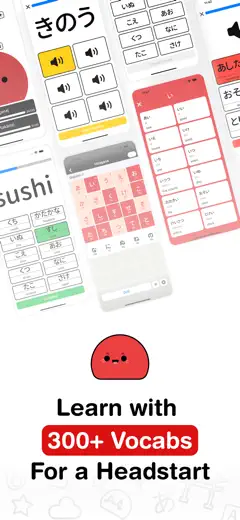
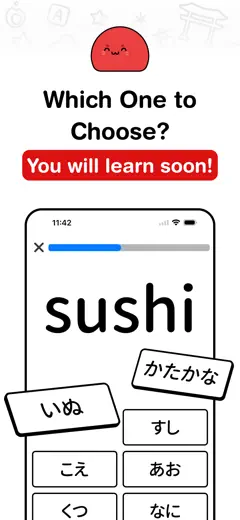
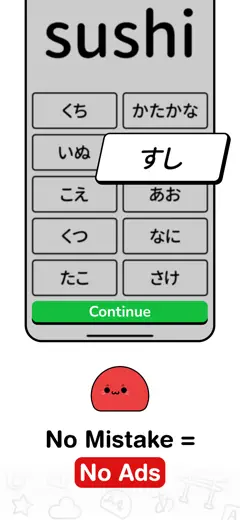
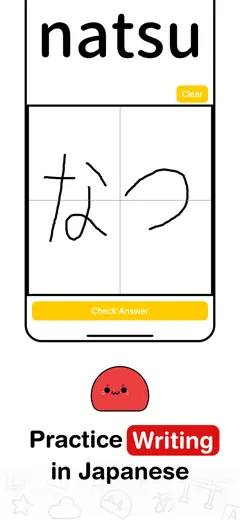
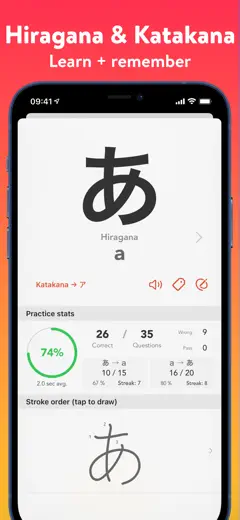
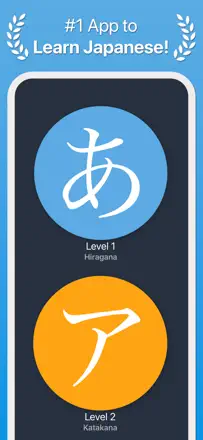
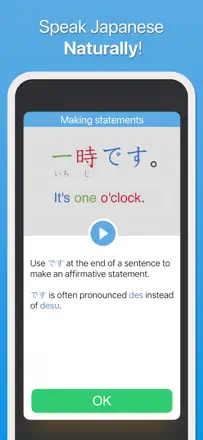
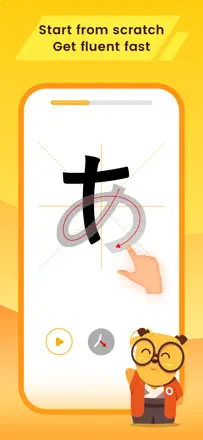
The best tool for memorizing hiragana and katakana: multiple exercise types, spaced repetition, a charming character, and ads that only appear when you make mistakes, which motivates you to be more accurate.
Points forts
Users memorize hiragana in one to two weeks, varied exercise formats keep things from getting stale, and audio feedback plus the Maru character make sessions genuinely enjoyable.
Reproches
Covers only kana, with no grammar, kanji, or vocabulary, so once you master the writing system you need to move to another app. On iOS 18 it fails to launch for some users.
Pour qui : Complete beginners in Japanese who need to master hiragana and katakana quickly and reliably before moving on to grammar and vocabulary.
Note des avis : 88 sur 100. Note sur l’App Store : 4,9★ · 11 518 notes
88sur 100
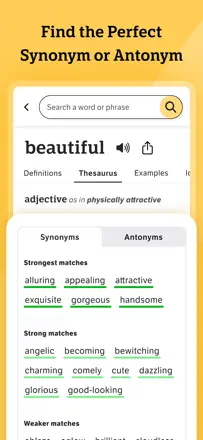
Not a language course in the traditional sense, but the best tool for deeply understanding English vocabulary through etymology. It helps words stick for good, unpacks Latin and Greek roots, and clarifies shades of meaning. Functionality is minimal but precise.
Points forts
Lightning-fast search, an authorial voice with humor, and word roots on the home screen as a starting point for exploration. Users spend hours falling down etymological rabbit holes.
Reproches
Does not teach speaking and provides no grammar. Narrow focus: word origins only. Without a foundation in English the app is nearly useless.
Pour qui : Native speakers and advanced learners who want to understand English from the inside rather than just know words.
Note des avis : 85 sur 100. Note sur l’App Store : 4,8★ · 12 376 notes
85sur 100
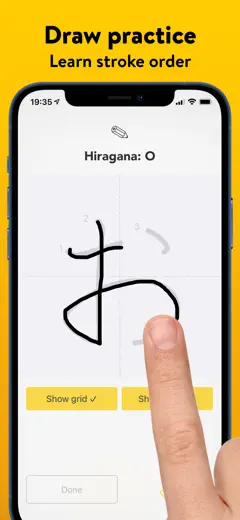
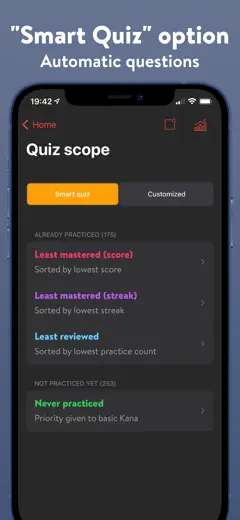
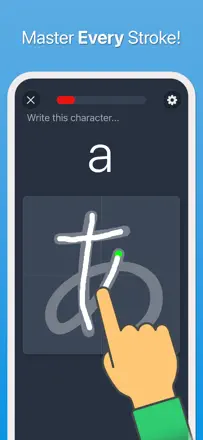
A tool for mastering hiragana and katakana through handwritten input, stroke order, and detailed per-character progress stats, with all content accessible without restrictions.
Points forts
The handwriting input feature accepts drawn characters and shows stroke order, per-character progress is visible at a glance, and sessions run without intrusive ads.
Reproches
The smart quiz algorithm sometimes gets stuck on the same characters and stops testing katakana. The app assumes you want to reinforce existing knowledge rather than learn characters from scratch.
Pour qui : Japanese learners who have already encountered the characters and want to solidify them through regular short tests, including handwritten input.
Rang 4. Note des avis : 85 sur 100. Note sur l’App Store : 4,8★ · 9 350 notes
85sur 100
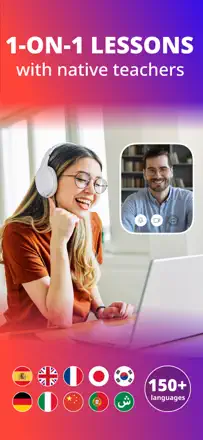
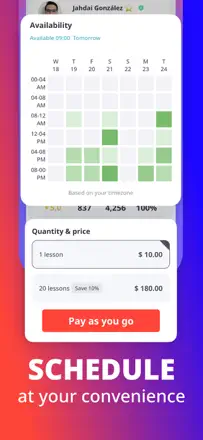
A marketplace of live teachers and language partners, and the only reliable way to reach real speaking practice. Huge choice of languages and formats, with native speakers available for almost any language in the world. Quality depends on the teacher you pick, but the search tools and reviews help.
Points forts : Live sessions with native speakers matched to your level, the choice between a structured lesson or conversation practice, and a wide range of languages including rare ones.
Reproches : The app is just a storefront: it does not teach on its own. You have to find a good teacher yourself. Without independent practice between sessions, progress is slow.
Pour qui : Those who want real speaking practice with a live person and are ready to commit to regular sessions.
Rang 5. Note des avis : 81 sur 100. Note sur l’App Store : 4,9★ · 5 128 notes
81sur 100
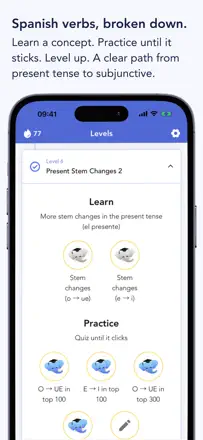
The best tool for systematically mastering Spanish conjugation. The adaptive system identifies gaps and skips what you already know. It does not replace a full course, but it covers the most painful gap, verb forms, better than any other app.
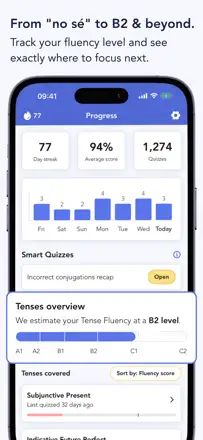
Points forts : An adaptive placement test immediately surfaces weak tenses. A variety of exercise types and customization (choosing tenses, regular and irregular verbs) let you target exactly what you need.
Reproches : Focused on one task: conjugation. No listening, no speaking, no vocabulary beyond verb forms. Not enough to reach fluent speech on its own.
Pour qui : Beginners and intermediates who feel verb forms are their main bottleneck. Works great alongside any Spanish course.
Rang 6. Note des avis : 78 sur 100. Note sur l’App Store : 4,7★ · 27 768 notes
78sur 100
An audio course that teaches speaking and listening comprehension through active recall from the very first lesson. Spaced repetition is built into the audio: the app asks you to reproduce a phrase at increasing intervals. Users with five languages under their belt call Pimsleur the best method for reaching conversational fluency. Grammar is not explained explicitly but absorbed through context.
Points forts : You can learn hands-free with no screen: lessons run 30 minutes and only require earphones. Several users report having real conversations with native speakers after finishing the first level, a concrete result rather than just a feeling of progress.
Reproches : No written component and no grammar explanations. For learners who study through reading and systematic analysis the method works poorly. Difficulty cannot be adjusted: the app starts from zero regardless of your existing knowledge.
Pour qui : Those who want to speak and understand spoken language, learn on the go, and are comfortable with an audio-only format without visual support.
Rang 7. Note des avis : 78 sur 100. Note sur l’App Store : 4,8★ · 9 802 notes
78sur 100
One of the few tools that genuinely builds listening comprehension and reading ability through immersion in real content. Users choose their own materials, words are tracked automatically, and progress is visible. Weak spots: clunky interface and inaccurate translations for some languages (Japanese).
Points forts : You can read and listen to any content in your target language, click unfamiliar words, and see a contextual translation. One user reached conversational Ukrainian in two years.
Reproches : No grammar explanations and no pronunciation feedback. The interface is cluttered. Not a good fit for absolute beginners: a foundation is required.
Pour qui : Those who already know a few hundred words and want to reach a level of understanding authentic speech through reading and listening.
Rang 8. Note des avis : 78 sur 100. Note sur l’App Store : 4,9★ · 3 742 notes
78sur 100
A strict conjugation trainer with flexible settings for tenses and dialects, available as a one-time purchase. It delivers something other apps do not: systematic drilling of conjugations until they become automatic.
Points forts : Flexible settings let you choose the tenses, dialect, and verb type you need. Audio pronunciation helps you internalize stress shifts as forms change. A wide database covers rare and irregular verbs.
Reproches : Conjugation only, with no context of how forms are used in sentences, no speaking practice, and no listening. Without a baseline vocabulary using the app from day one is difficult.
Pour qui : Intermediates and advanced learners who know Spanish but get confused on tenses and irregular verbs. Works great as a daily warm-up alongside a main course.
Rang 9. Note des avis : 74 sur 100. Note sur l’App Store : 4,8★ · 196 906 notes
74sur 100
The best tool for serious Spanish study: a deep dictionary with contextual examples and conjugation tables, flashcards, grammar lessons, and video from native speakers. Several users state outright that they reached fluency with it.
Points forts : A dictionary with full conjugation tables and usage examples. Dialogues with real Spanish-speaking users to check written responses. Flashcards built from any word encountered during search.
Reproches : Spanish only. The app heats up the phone when adding words to decks. Speech recognition switches languages mid-dialogue. Performance lags during real-time search.
Pour qui : Anyone seriously studying Spanish, from beginner to B2 and beyond. Especially powerful for independent reading paired with vocabulary building.
Rang 10. Note des avis : 74 sur 100. Note sur l’App Store : 4,8★ · 21 761 notes
74sur 100
A specialized app for learning hiragana, katakana, and basic kanji through drawing characters with a finger or stylus. Combines handwriting recognition with pronunciation and spaced repetition. Users migrating from Duolingo note that here they finally learned to read rather than guess from pictures. Speaking practice and advanced grammar are not included.
Points forts : Practice writing characters directly in the app: it recognizes strokes and corrects the stroke order. On an iPad with Apple Pencil this brings learning close to using an actual notebook.
Reproches : Covers only the beginning of the journey: kana and basic kanji. Speaking is not practiced. A solid tool for reading and writing but not for reaching spoken fluency.
Pour qui : Those starting Japanese who primarily want to learn to read and write the syllabaries as a foundational first step before grammar and vocabulary.
Rang 11. Note des avis : 74 sur 100. Note sur l’App Store : 4,8★ · 15 228 notes
74sur 100
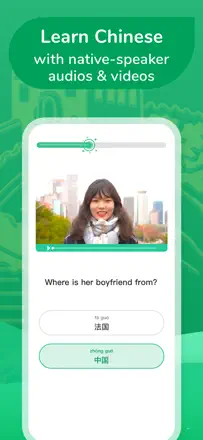
A comprehensive Mandarin course for beginners where characters are explained with meaning and pronunciation from the start. The speech analysis feature genuinely helps users hear the difference in tones.
Points forts : Depth of material delivery: every character is explained with meaning, examples, and pronunciation together. The feature that compares your speech to a native speaker helps correct tones. Around 50 hours of content available.
Reproches : No option to hide translations for users who already know the words. The app freezes in immersion mode, and offline mode is advertised but does not work for some users.
Pour qui : Beginners and intermediates seriously committed to learning Mandarin who want to work on all skills, pronunciation, writing, and listening comprehension, in one app.
Rang 12. Note des avis : 74 sur 100. Note sur l’App Store : 4,7★ · 9 086 notes
74sur 100
A unique platform: language questions answered by native speakers through crowdsourcing. Lets you sort out nuances, idioms, and conversational forms that textbooks miss. Does not replace a course but complements any other tool well.
Points forts : Live native speakers explain the difference between similar expressions, flag unnatural phrasing, and give examples of real usage.
Reproches : Does not teach basic grammar or build vocabulary: it only answers specific questions. Answer quality varies depending on community activity for your target language.
Pour qui : Those already studying a language who want to ask a native speaker a targeted question about nuance, register, or whether a phrase is correct.
Rang 13. Note des avis : 72 sur 100. Note sur l’App Store : 4,9★ · 53 288 notes
72sur 100
One of the few apps that teaches word pronunciation syllable by syllable from the first lesson, explains the literal meaning, and immediately provides a situational dialogue. Users across different age groups report real retention in a short time.
Points forts : Word-by-word and phoneme-by-phoneme explanation: the word is broken down, each syllable shown, and each part spoken separately. Situational dialogues after each block reinforce speech in context. Several languages (Japanese, Korean, French) are developed more deeply than competitors.
Reproches : The French course is incomplete: some units are empty. Romanization in Japanese and Korean is on by default and cannot be turned off, which interferes with learning the original writing system. Speech recognition sometimes does not handle accented pronunciation.
Pour qui : Beginners and intermediates who want to speak from day one and understand word structure. Works especially well for Korean and Japanese.
Rang 14. Note des avis : 72 sur 100. Note sur l’App Store : 4,8★ · 27 441 notes
72sur 100
A course with full grammar explanations aimed at Asian languages: Korean, Japanese, Chinese. Each lesson breaks down language structure rather than just listing vocabulary. Short videos with native speakers appear at the end of each section. In depth of grammar delivery it surpasses most mobile alternatives.
Points forts : Grammar is presented as a system: Korean particles, Japanese case markers. The app shows the logic instead of asking you to memorize. Native video clips at the end of each lesson provide a sample of natural speech.
Reproches : Does not develop speaking: no speech recognition, no conversational practice. The app builds comprehension and reading, but reaching spoken fluency will require additional tools.
Pour qui : Those seriously tackling Korean or Japanese who want to understand grammar rather than simply recognize words.
Rang 15. Note des avis : 72 sur 100. Note sur l’App Store : 4,9★ · 15 477 notes
72sur 100
A video-driven course in Korean and English built around scenes from real films and clips. The strongest feature is authentic speech: words are learned in living context, you can slow the video, and there is a repeat-after-me mode. Works especially well for users drawn in by K-pop and dramas.
Points forts : Users note that Hangul sticks quickly thanks to structured lessons. The video format with pause and repeat gives a feel for the intonation and pace of natural speech. Content featuring BTS and other groups keeps motivation high.
Reproches : Most content is behind the Cake Plus paywall. Phonetic transcription (Latin alphabet) is not always provided, which hampers pronunciation in the early stages. Deep grammar is sparse: the app builds vocabulary and listening comprehension but does not explain language structure.
Pour qui : Beginners, especially fans of K-pop and Korean culture, who want to understand spoken language and say basic phrases rather than study grammar academically.
Rang 16. Note des avis : 72 sur 100. Note sur l’App Store : 4,8★ · 11 384 notes
72sur 100
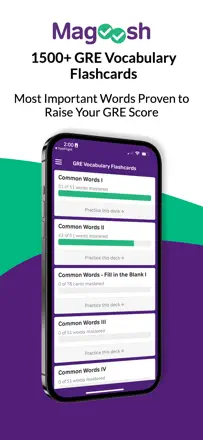
A reliable GRE prep tool with 1,000 words, pronunciation, and sentence examples. The repetition algorithm works, and one user raised their score from 148 to 158 in two weeks.
Points forts : Three difficulty tiers, audio pronunciation, a three-bucket sorting system by mastery level, fully accessible without restrictions, and it genuinely helps retain test vocabulary.
Reproches : Narrow exam vocabulary does not transfer to real conversation. No contextual stories, speaking, or grammar, and progress is lost during technical failures with no way to restore it.
Pour qui : Those taking the GRE who want to build their written vocabulary quickly.
Rang 17. Note des avis : 72 sur 100. Note sur l’App Store : 4,8★ · 3 560 notes
72sur 100
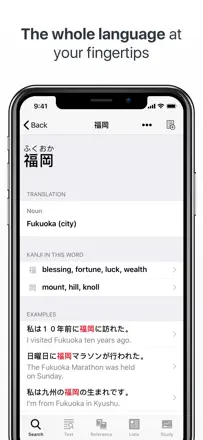
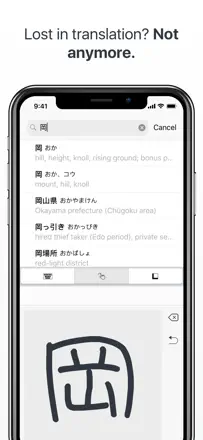
A comprehensive Japanese dictionary with handwriting search, radical-based kanji lookup, built-in spaced repetition, and offline mode. Indispensable when reading authentic texts.
Points forts : Handwriting search, kanji breakdown by radicals, spaced repetition, and offline functionality make it an essential companion for anyone studying Japanese through immersion in real texts.
Reproches : The spaced repetition system has not been updated in a long time and lags behind dedicated apps. No structured lessons for beginners, and without a foundation in hiragana and grammar using it is difficult.
Pour qui : Japanese learners at intermediate level and above who read authentic texts and need a reliable dictionary at hand. Beginners are better served by another tool first.
Rang 18. Note des avis : 71 sur 100. Note sur l’App Store : 4,7★ · 32 354 notes
71sur 100
A structured Spanish course from the alphabet to sentences, with an emphasis on explaining grammar before practice. The key differentiator from competitors: the app explains the rule and then tests you, not the other way around. No life limit, which reduces test anxiety. Suitable for children and adults with no prior knowledge.
Points forts : Sequential introduction of material: numbers and alphabet first, then basic verbs, then sentences. Users who already have some Spanish say the app helps fill in structural gaps.
Reproches : Built for A0 to A2: the app does not go beyond the beginner level, grammar becomes shallow further in, and speaking practice is absent entirely.
Pour qui : Absolute beginners in Spanish, especially school-age children and adults with no prior experience, who need a clear structure from zero.
Rang 19. Note des avis : 71 sur 100. Note sur l’App Store : 4,8★ · 8 164 notes
71sur 100
British Council podcasts with transcripts, a vocabulary section, and comprehension exercises. The live dialogues and interviews deliver real English without scripted textbook language. An excellent tool for building listening comprehension at B1 to C1 level.
Points forts : Transcripts in sync with the audio, content covering real-world topics, and authentic British pronunciation without theatrical delivery.
Reproches : No speaking, no grammar explanations. One format only: listening. Too advanced for beginners.
Pour qui : Those who read English at B1 level and above and want to train their ear to natural British speech.
Rang 20. Note des avis : 70 sur 100. Note sur l’App Store : 4,7★ · 98 982 notes
70sur 100
One of the few apps that genuinely teaches speaking and explains grammar: structured lessons, videos with native speakers for Spanish, and community checking of written answers. Users compare it to a classroom course.
Points forts : Grammar rules explained in the context of phrases. Lessons build from simple to complex without skipping ahead. Written exercises checked by real native speakers. Video recordings with native speakers for Spanish provide authentic speech.
Reproches : Voice recognition is unstable and sometimes marks a wrong answer as correct. The interface responds with a lag. Not all languages are developed equally well: Japanese is not as thorough as Spanish.
Pour qui : Adults who want to study a language systematically and get to conversational speech. Especially for those who care about grammar.
Rang 21. Note des avis : 70 sur 100. Note sur l’App Store : 4,8★ · 9 252 notes
70sur 100
A structured course from EF with lessons, grammar, listening practice, and pronunciation drills. Clearly divided into levels from A1 to C1. One of the few tools with a full grammar program in mobile format.
Points forts : Transparent level-based course structure, authentic audio dialogues, variety of exercise types, and a clear sense of progress.
Reproches : Speaking is limited to repeating modeled phrases with no free dialogue. Lacks live pronunciation feedback.
Pour qui : Those who want a structured English course from zero to intermediate level at their own pace.
Rang 22. Note des avis : 69 sur 100. Note sur l’App Store : 4,8★ · 44 209 notes
69sur 100
One of the strongest apps in terms of content depth: grammar inferred through exercises rather than memorized rules, cultural notes, and a wide language selection including rare ones. Reliably takes you to B2, after which the content runs out.
Points forts : Grammar learned through inference from examples rather than rule memorization. Cultural notes explain why people say what they say. Over 70 languages including Arabic, Tagalog, and Scottish Gaelic. Lessons build comprehension from phrase to structure.
Reproches : The Japanese course excludes kanji, which blocks real literacy. Content ends before B2 for most languages. The review cards at the end of a chapter are weaker than the main lessons and offer no explanations.
Pour qui : Adults who want a structured language immersion from zero to basic communication. Often available for free through public libraries.
Rang 23. Note des avis : 68 sur 100. Note sur l’App Store : 4,9★ · 110 253 notes
68sur 100
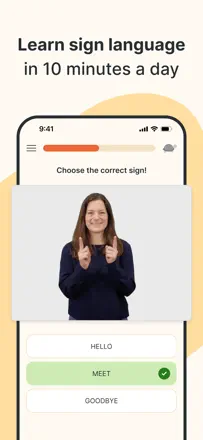
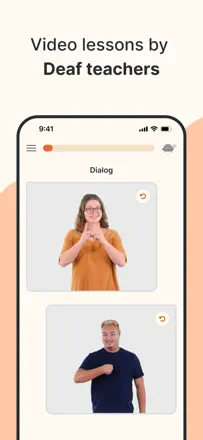
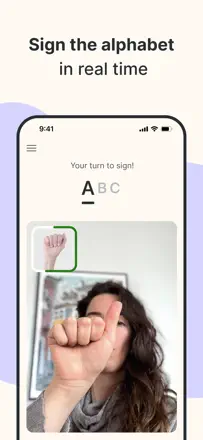
The best mobile option for learning American Sign Language: Deaf educators, video lessons with variable speed, and a camera feature to check your own signs. Reviewers report real learning progress in a short time.
Points forts : Instructors from the Deaf community, giving authentic signing and cultural context. The ability to slow video and watch a sign from different angles. A camera verifies whether the user's sign is correct.
Reproches : Once all chapters are done the content ends and there is no advanced path. The app is not fully accessible for blind users. Fingerspelling appears late in the course, though many would prefer to start with it.
Pour qui : Hearing people who want to communicate with Deaf coworkers, family members, or students. Healthcare workers, teachers, and parents of Deaf children.
Rang 24. Note des avis : 68 sur 100. Note sur l’App Store : 4,9★ · 36 047 notes
68sur 100
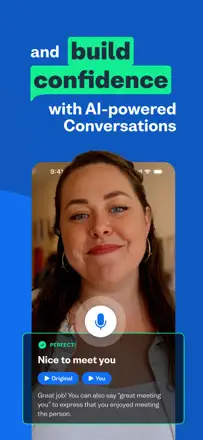
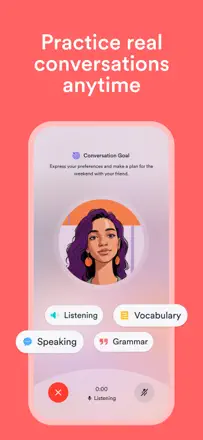
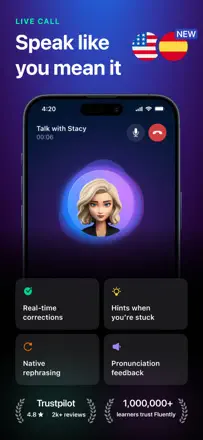
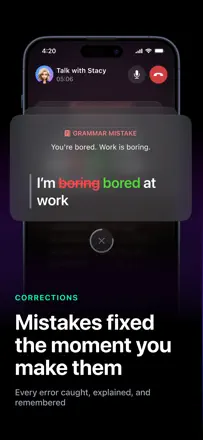
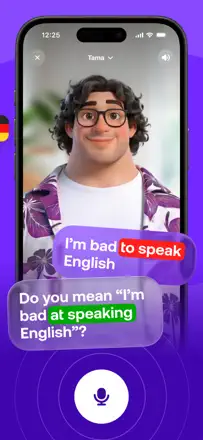
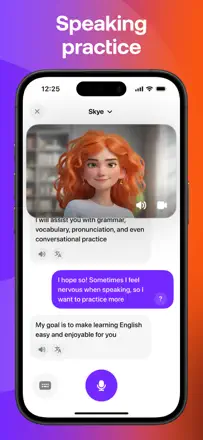
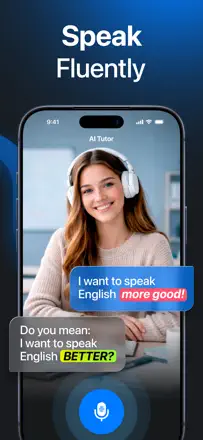
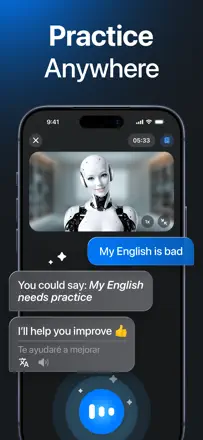
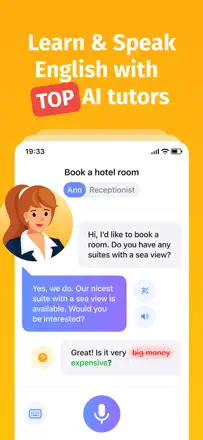
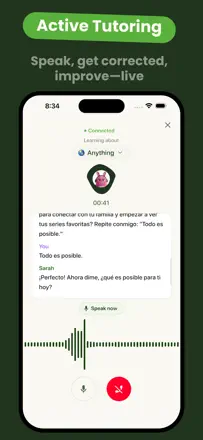
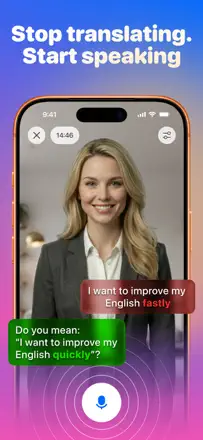
An AI conversation partner for spoken English practice: the app listens, responds in real time, and flags pronunciation and grammar errors. For many users this is their first experience speaking English without fear of judgment, and the psychological barrier genuinely drops. Depth of grammar explanations is limited and the app does not deliver a structured course, but it creates a space for conversational practice.
Points forts : Speaking without fear of making mistakes: the AI is patient, waits for your answer, and does not judge. Immediate pronunciation correction after each response lets you track specific errors in real time while speaking.
Reproches : Does not build a language system: no sequential grammar course, no structural explanations. For a complete beginner the app will be too demanding since it assumes a basic vocabulary is already in place.
Pour qui : Those who understand English but are afraid to speak and want regular conversational practice without a live partner.
Rang 25. Note des avis : 68 sur 100. Note sur l’App Store : 4,9★ · 17 483 notes
68sur 100
The best structured Japanese grammar textbook in app form, with explanations, examples, and JLPT-level organization, though the exercises do not quite match the quality of the explanations.
Points forts : Clear grammar explanations with multiple examples per rule, JLPT-level structure that suits serious learners, and a lifetime purchase that is seen as fair value for the volume of content.
Reproches : No speaking practice or listening comprehension, only text-based exercises. Audio in some tasks cannot be slowed down, and the JLPT section introduces kanji that were not covered in earlier lessons.
Pour qui : Independent learners of Japanese or Spanish who need clear grammar with explanations rather than just guessing words.
Rang 26. Note des avis : 68 sur 100. Note sur l’App Store : 4,5★ · 9 326 notes
68sur 100
On-demand spoken English practice with native speakers is the app's core strength. You can connect at any time of day without booking in advance. It teaches speaking specifically, not grammar or reading. Additional tools are needed for systematic language study.
Points forts : Available any time, a diverse roster of tutors from the US and UK, and an informal format that lowers the barrier to live conversation.
Reproches : No structured program: tutors do not always know what to do with a student. Without self-directed preparation between sessions, systematic progress is slow. Expensive with frequent use.
Pour qui : Those with a foundation in English (A2 and above) who want live conversation practice without scheduling in advance.
Rang 27. Note des avis : 66 sur 100. Note sur l’App Store : 4,8★ · 20 920 notes
66sur 100
A flashcard app with spaced repetition where you rate your confidence on a scale of 1 to 5 and the algorithm adjusts how often a card appears. For language learning it works as a vocabulary retention tool, but you need to create your own deck or find a pre-made one. The app's strength is in honest self-assessment of knowledge rather than a false sense of progress.
Points forts : The self-rating mechanic after each card is more accurate than a binary correct/incorrect: you can mark a word as known but uncertain and the algorithm will return it sooner. Shared decks let you learn from sets others have built.
Reproches : It does not teach a language, it helps you memorize things. That is a fundamental difference. No audio by default, no grammar, no example sentences unless you add them manually. A tool to supplement a course, not replace one.
Pour qui : Those already studying a language through a course or with a tutor who want to systematize vocabulary retention through spaced repetition.
Rang 28. Note des avis : 65 sur 100. Note sur l’App Store : 4,7★ · 23 331 notes
65sur 100
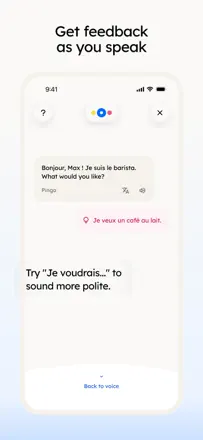
An AI tutor for spoken Spanish and English practice through role-play scenarios: a cafe, a doctor's appointment, work. The app hears your speech, responds, and flags conjugation and pronunciation errors in real time. Users coming from Duolingo notice the difference: there they read and clicked, here they speak. Limitation: only two languages, no sequential grammar course.
Points forts : Conversational scenarios close to real situations: the AI holds a full dialogue rather than just waiting for a correct answer. One user, after four years of Duolingo, started speaking Spanish for the first time here.
Reproches : Does not build a grammar foundation: no structural explanations, only in-the-moment corrections. Beginners without a base will struggle since the dialogue pace is too fast without prior pattern practice.
Pour qui : Those who know Spanish or English at a beginner level and want to move from reading and tests to real speaking.
Rang 29. Note des avis : 65 sur 100. Note sur l’App Store : 4,7★ · 12 266 notes
65sur 100
An audio dictionary with a hands-free mode that builds pronunciation and a basic lexicon passively, but it does not teach grammar and the vocabulary range is limited even in the full version.
Points forts : The hands-free mode lets you listen to words and phrases while moving or working. Playback speed adjusts smoothly, and repeated listening at a controlled pace produces a noticeable memorization effect.
Reproches : No grammar, no dialogue practice, and no example sentences in context. Microphone feedback is opaque: it is unclear whether your pronunciation is correct. The full version contains around 1,300 words with no level progression.
Pour qui : Tourists or complete beginners who need to learn a few hundred French words with correct pronunciation before a trip or as a first exposure to the language.
Rang 30. Note des avis : 65 sur 100. Note sur l’App Store : 4,8★ · 7 980 notes
65sur 100
A structured English course with grammar, vocabulary, and exercises for levels A1 to B2. Progression is clear and explanations are accessible. No live speaking and no listening with native speakers: it teaches rules, not speech.
Points forts : Clear grammar explanations, variety of exercise types, a clean uncluttered interface, and a well-defined level progression.
Reproches : No speaking practice and no free listening comprehension. Teaches sentence construction by rule but does not lead to live communication.
Pour qui : Those who want to build a grammatical foundation in English at their own pace without competitive pressure.
Rang 31. Note des avis : 63 sur 100. Note sur l’App Store : 4,8★ · 10 390 notes
63sur 100
BBC audio content at a real B2 to C1 level with transcripts, a vocabulary section, and comprehension questions. A real-world podcast format delivers authentic English rather than textbook dialogues. Weak spot: app instability after updates.
Points forts : Live BBC presenters with British pronunciation, texts on real topics (science, culture, society), and a synchronized transcript that helps you follow along.
Reproches : Does not teach speaking and provides no grammar. All content is listening-only. No level labeling, making it hard for an A2 user to know where to start.
Pour qui : Those who already read English at B1 and above and want to train listening comprehension for real spoken language.
Rang 32. Note des avis : 62 sur 100. Note sur l’App Store : 4,8★ · 321 356 notes
62sur 100
A reliable authoritative dictionary with etymology, related meanings, and word games. Good for intentional vocabulary expansion by native speakers, not for learning a foreign language.
Points forts : Detailed etymology and word history. A word-of-the-day feature with cultural context. Built-in thesaurus. Offline mode. Genuinely challenging word games and quizzes.
Reproches : Not a language learning tool: no exercises, no level-based structure, no pronunciation practice. Will not help foreign language learners. Individual words are missing from the database.
Pour qui : Native English speakers who love words: writers, students, and people preparing for exams like the SAT or GRE.
Rang 33. Note des avis : 62 sur 100. Note sur l’App Store : 4,8★ · 41 089 notes
62sur 100
A Duolingo alternative with real grammar explanations, which is the differentiator users mention most. The app explains why a phrase is structured the way it is rather than just asking you to repeat it. Vocabulary progression is sequential. Weak spots: AI-generated illustrations irritate some users and speaking practice is minimal.
Points forts : Grammar explanations built into the lesson: the app shows the difference between formal and informal address in French, explains cases, without referring you to external resources. Several users say they learned more Japanese in two days than in forty days with a competing app.
Reproches : Does not lead to speech: no free conversational exercises, only multiple-choice and translation. Users complain about not being able to choose which exercises to review, and the progression sometimes jumps topics.
Pour qui : Beginners and intermediates who want to understand grammar rather than simply memorize phrases by rote.
Rang 34. Note des avis : 62 sur 100. Note sur l’App Store : 4,5★ · 14 594 notes
62sur 100
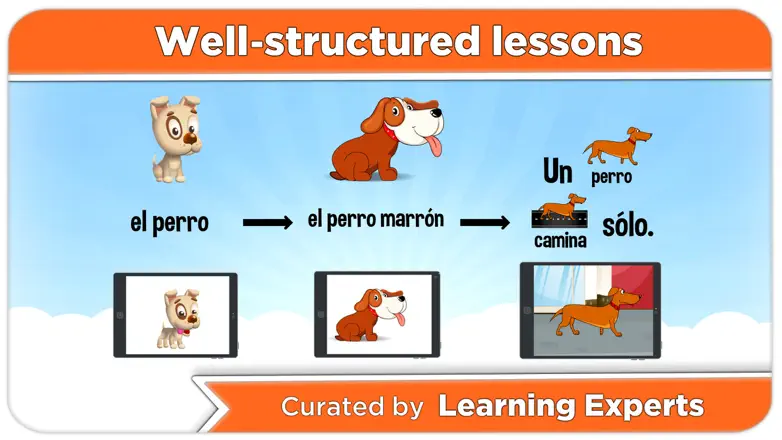
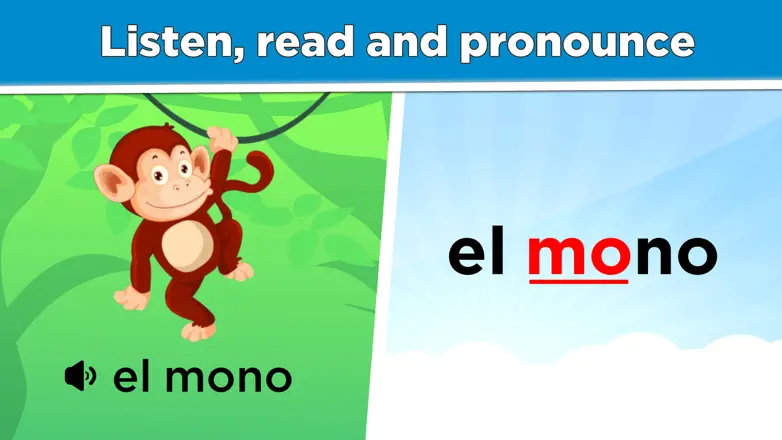
A gamified Spanish course for children ages 4 to 10 with animation, mini-games, and basic vocabulary. One of the few honest options for preschoolers and early elementary children. The vocabulary is limited (colors, animals, numbers, food) and oriented toward recognition rather than speech, so the ceiling is reached quickly.
Points forts : Parents note that children return to the app on their own and genuinely remember words. The game format holds attention. Several parents of children with speech delays reported noticeable progress.
Reproches : Speech recognition works poorly with children's voices: kids pronounce correctly but the app does not accept it. The program covers only basic vocabulary and runs out quickly. After 25 medals progress stalls on material that was never introduced.
Pour qui : Children ages 4 to 10 taking their first steps with Spanish, especially in families where parents do not speak Spanish themselves and want playful home support.
Rang 35. Note des avis : 62 sur 100. Note sur l’App Store : 4,7★ · 9 583 notes
62sur 100
A solid audio trainer for building German vocabulary: good pronunciation, hands-free listening, and vocabulary grouped by topic. One user held a ten-minute conversation with a native speaker after two months. Grammar and noun cases are largely absent.
Points forts : Hands-free listening while driving, clear Bavarian pronunciation, adjustable playback speed, and gradual introduction of new words without overload.
Reproches : Nouns without articles, a critical gap for German. No cases or grammar, only words and basic phrases. Once past the beginner stage there is nowhere to grow.
Pour qui : Beginners who want to build a basic German vocabulary quickly, especially convenient in the car or on a walk.
Rang 36. Note des avis : 62 sur 100. Note sur l’App Store : 4,7★ · 6 838 notes
62sur 100
The best mobile tool for learning to write kanji with spaced repetition and full JLPT coverage, available as a one-time purchase with no subscription.
Points forts : Spaced repetition with handwriting input via Apple Pencil, JLPT-level structure, the ability to hear a word in context, and real user progress after months of practice.
Reproches : Stroke order is incorrect for some kanji or the algorithm interprets it too strictly, there are pronunciation errors at higher levels, and there is no grammar or listening comprehension practice.
Pour qui : Japanese learners who want to systematically master kanji and related vocabulary. Should be paired with separate resources for grammar and speaking practice.
Rang 37. Note des avis : 61 sur 100. Note sur l’App Store : 4,8★ · 12 174 notes
61sur 100
A structured English vocabulary builder with a level placement test on entry, tiered progression, and the ability to add words to a personal journal. Outperforms competitors by placing each word immediately into context with a label. Weakness: rigid restrictions on editing added words and aggressive notifications.
Points forts : Users praise the placement test at first launch: the app positions you correctly straight away without making you start from "cat" and "dog." A personal word journal with flashcards lets you study specialized professional vocabulary.
Reproches : Words added to the journal cannot be freely edited afterward. Notifications arrive too frequently and cannot be turned off in any reasonable way. Some definitions and synonyms in the app are inaccurate. Pronunciation is synthetic with no audio from native speakers.
Pour qui : Above-intermediate users who want to deliberately build academic or professional English vocabulary and are willing to add their own words from their field.
Rang 38. Note des avis : 60 sur 100. Note sur l’App Store : 4,8★ · 49 281 notes
60sur 100
The app builds each lesson around video from a native speaker and AI pronunciation checking, and users who spent years on Duolingo without speaking report real progress here, though the language selection is small.
Points forts : Each lesson is built around a native-speaker video, phrase repetition, and AI pronunciation feedback. A hands-free mode lets you learn during a commute. Syllable-by-syllable breakdown genuinely helps place sounds.
Reproches : Only five or six languages are available. Speech recognition misses certain consonants. The Japanese tutor in question-and-answer mode systematically rejects correct answers.
Pour qui : Intermediate learners of Spanish, Korean, or Italian who want to move from reading to speaking. Not for complete beginners.
Rang 39. Note des avis : 60 sur 100. Note sur l’App Store : 4,7★ · 34 085 notes
60sur 100
Audio podcasts for language learning in a format where two native speakers converse and a third explains the structure. The method works for listening comprehension and picking up natural speech. Several users report a real breakthrough in Japanese, Russian, and Romanian. The mobile app is significantly thinner than the web version: no flashcards, no offline, and audio sometimes cuts out.
Points forts : Lessons built around real dialogues with cultural context rather than textbook phrases. Supports rare languages such as Romanian, Afrikaans, and Norwegian where almost no other resources exist.
Reproches : Audio only, no active speaking practice, and no pronunciation feedback. The immersion-through-listening method requires additional tools to reach speaking fluency.
Pour qui : Those who learn while commuting or walking and want to hear natural native speech with structural explanations, like an advanced audio textbook.
Rang 40. Note des avis : 58 sur 100. Note sur l’App Store : 4,8★ · 13 687 notes
58sur 100
The smartest tool for expanding English vocabulary: each word comes with an image, multiple contextual examples, frequency rating, and difficulty level. Spaced repetition is well-designed. The main problem is technical: crashes after updates lead to lost progress and failures during review sessions.
Points forts : Users praise how each word is delivered: image, a real sentence example, and a usage frequency number. This immediately puts the word in context rather than leaving it as a bare translation. IELTS and academic vocabulary packs are valued by serious learners.
Reproches : The app regularly crashes during word review and progress sometimes resets. AI-generated images are often unrelated to the word or poorly generated. No feature to choose the order of words yourself. New words are introduced in a fixed sequence determined by the app.
Pour qui : Above-beginner users who are deliberately expanding their English vocabulary, including for IELTS and TOEFL exams.
Rang 41. Note des avis : 58 sur 100. Note sur l’App Store : 4,8★ · 11 584 notes
58sur 100
A solid grammar and vocabulary trainer for beginners: picture-based exercises, step-by-step rules, and detective story supplements. Does not lead to conversational speech since the focus is on rules and recognition rather than independent speaking.
Points forts : Users praise the step-by-step grammar explanations with examples, memorability through pictures, and the fact that sessions do not feel like a chore the way competitors' can.
Reproches : No speaking or listening practice beyond the beginner level. Advanced learners hit the ceiling quickly. The app interface is not translated into English, which is a barrier for those learning the language from scratch.
Pour qui : Those starting English from zero or reinforcing A1 to B1 grammar in a game format.
Rang 42. Note des avis : 57 sur 100. Note sur l’App Store : 4,6★ · 3 675 notes
57sur 100
An advanced spaced repetition system that places words in sentence context and requires typing the answer rather than selecting from options. Good for strengthening vocabulary at the intermediate level. Suffers from sentence repetition and an algorithm that gets stuck in a loop.
Points forts : Mandatory typing instead of multiple choice forces genuine recall. Progress tracking and grammar hints are useful for B1 and above.
Reproches : The algorithm cycles: the same words appear again and again while new ones are added slowly. No speaking practice, no listening in a communicative context.
Pour qui : Learners of German, French, Spanish, or Russian at A2 to B2 who need to systematically expand their vocabulary. Not for beginners or those who want to speak.
Rang 43. Note des avis : 55 sur 100. Note sur l’App Store : 4,8★ · 92 521 notes
55sur 100
Genuinely focused on speaking from the very first second: repeat aloud, grammar footnotes in context. Speech recognition is unreliable and accepts incorrectly pronounced words as correct. Vocabulary is basic and the path to free speech is unclear.
Points forts : Conversational format from the very first lesson. Brief grammar explanations embedded within phrases. Wide language selection including rare ones. Easy to get started without setup.
Reproches : Speech recognition misfires in both directions: it accepts what you say incorrectly as correct and rejects correct input. Errors in several languages (Indonesian, Norwegian). The live AI dialogue follows a fixed script and does not respond when you deviate from it.
Pour qui : Travelers and beginners who need conversational basics quickly. For deep study of a single language a better tool is advisable.
Rang 44. Note des avis : 55 sur 100. Note sur l’App Store : 4,8★ · 42 097 notes
55sur 100
A tutor marketplace where live sessions with a well-chosen teacher genuinely produce progress in Japanese and Mandarin, but the platform provides no tools for self-directed practice between lessons.
Points forts : Choosing a teacher by specialization and level makes sessions targeted. Live interaction with a native speaker gives immediate feedback on pronunciation and grammar.
Reproches : You improve only as fast as your teacher's schedule allows. There are no tools for independent practice between lessons, and a missed session means losing paid time.
Pour qui : Those willing to pay for structured live lessons who already know which language and which accent they want.
Rang 45. Note des avis : 55 sur 100. Note sur l’App Store : 4,8★ · 23 782 notes
55sur 100
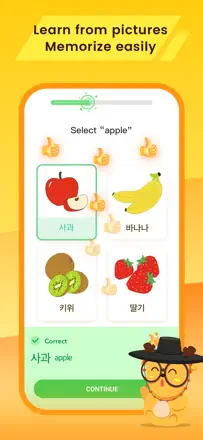
A vocabulary game app for Korean using the Drops format: a word is animated and broken into parts, then reinforced through several exercise types with illustrations. Keeps interest high through a visual format. Limitation: vocabulary only with no pronunciation and no grammar. You can learn what things are called in Korean but not how to build a sentence.
Points forts : Step-by-step word animation with syllable breakdown helps with sound retention. Visual associations work for kinesthetic and visual learners. Several users say words "stick" better than with traditional flashcards.
Reproches : Teaches a word game rather than a language: no Hangul as a system (reading is not taught), no grammar, and no listening practice. After a week of active use you know words but cannot form a single sentence.
Pour qui : Those just starting to explore Korean who want to build a basic vocabulary through a game format as a first step before a serious course.
Rang 46. Note des avis : 55 sur 100. Note sur l’App Store : 4,7★ · 16 374 notes
55sur 100
A timed English grammar, spelling, and vocabulary quiz game. Good for training intuitive response speed and spotting gaps. But the app tests rather than teaches: no rule explanations, no context, no grammar breakdowns. Oriented toward British English.
Points forts : Users enjoy the thrill of the timed mode: 60 seconds leaves no time to think and forces automatic recall. Multiple categories (grammar, spelling, vocabulary, antonyms) provide variety.
Reproches : Teaches you to pass the test, not the language: a wrong answer shows the correct one without explanation. The timer is too strict for learners as opposed to native speakers. Some questions are flawed: two correct spellings are offered as alternatives. Questions repeat quickly.
Pour qui : Intermediate and above users who want to keep already-acquired English knowledge sharp, not those learning from scratch.
Rang 47. Note des avis : 55 sur 100. Note sur l’App Store : 4,7★ · 10 008 notes
55sur 100
A structured Hangul alphabet trainer with stroke order and repetition, though the pronunciation of some consonants is incorrect and the app effectively ends once the alphabet is covered.
Points forts : Writing exercises with stroke order and a calm pace allow you to master Hangul in one to two months with daily practice. A one-time purchase with no recurring charges.
Reproches : The pronunciation of several consonants is incorrect and the synthesized voice does not capture natural speech. After mastering the alphabet the app offers no words, phrases, or grammar to continue with.
Pour qui : Those who want to learn to read Hangul from scratch before moving to a full Korean course.
Rang 48. Note des avis : 55 sur 100. Note sur l’App Store : 4,7★ · 6 899 notes
55sur 100
A rare learning app where grammar rules are stated explicitly rather than just inferred from examples. Well-structured for independent French study from zero. The heart system is frustrating and the voice recording feature is unreliable.
Points forts : Direct grammar explanations with examples and a logical topic sequence. Users switching from Duolingo say they finally understand why a sentence is structured the way it is.
Reproches : Does not lead to conversational speech: pronunciation practice is limited, voice recording is glitchy, and the heart system interrupts the flow of study at the worst moments.
Pour qui : Adult beginners who want to understand the logic of French grammar rather than just memorize phrases. Works well alongside live speaking practice.
Rang 49. Note des avis : 53 sur 100. Note sur l’App Store : 4,6★ · 13 845 notes
53sur 100
The widest coverage of rare languages among the apps tested: Tagalog, Thai, Khmer, Mongolian, and dozens more. The basic lesson structure of phrase, translation, native-speaker audio, and writing practice works. Main weakness: beginners are dropped into sentences without an explanation of the alphabet, and the speaking practice feature is not available for all languages.
Points forts : Learners of rare languages have no comparable alternative in terms of breadth. Audio from claimed native speakers sets the app apart from many competitors. Tagalog users complete full courses and praise the structure.
Reproches : Beginners are thrown into sentences without an introduction to basic characters, which is especially acute for Thai, Khmer, and Tamil. Speaking practice does not work for all languages. Translations in some languages contain errors. Abrupt jump to complex structures without gradual buildup.
Pour qui : Learners of rare languages (Tagalog, Thai, Khmer, Swahili) for whom Ling is the only structured mobile option. For widely spoken languages better alternatives exist.
Rang 50. Note des avis : 52 sur 100. Note sur l’App Store : 4,7★ · 303 695 notes
52sur 100
The app's main strength is live dialogue with an AI tutor: users practice speaking from the first lesson and receive corrections as they go. The main weakness is unreliable speech recognition that frequently fails to understand input.
Points forts : Conversational format from the first session: the AI teacher corrects pronunciation and sentence structure. Several users report feeling confident in conversation after just a few days.
Reproches : Speech recognition frequently misunderstands the user and continues the lesson with wrong input. The number of available languages is limited, and switching languages resets progress. Some supported languages perform poorly (Arabic, Japanese kanji with Chinese pronunciation).
Pour qui : Those who want to speak from the start and need a low-pressure AI conversation partner for daily practice.
Rang 51. Note des avis : 52 sur 100. Note sur l’App Store : 4,7★ · 20 371 notes
52sur 100
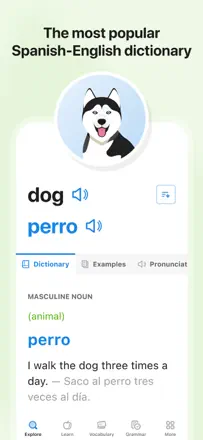
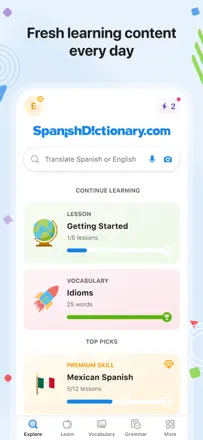
An offline Spanish-English dictionary and translator with a rich database of contextual sentence examples. The key strength: not just a word translation but several examples showing the word in different contexts. Translation accuracy is good at an everyday level, though nuances with regional Spanish varieties and dated forms occasionally appear. This is a reference tool, not a course.
Points forts : Sentence examples for every word: instead of one translation, several constructions in different contexts. Works fully offline. Pronunciation audio for most entries.
Reproches : Does not teach language: no structured lessons, no grammar, no interactive exercises. A reference tool, not a study app. Occasional errors in translations for less common words.
Pour qui : Spanish learners who need a reliable offline dictionary during reading or travel, and for anyone who needs quick translation without an internet connection.
Rang 52. Note des avis : 52 sur 100. Note sur l’App Store : 4,7★ · 5 853 notes
52sur 100
The comprehensible input method through video from real native speakers works, and users report progress in understanding conversational Spanish, but there is no output practice and intermediate-level content runs out quickly.
Points forts : Video from real native speakers with interactive word lookups lets you learn through comprehension of natural speech in context. Users report progress in understanding conversational Spanish within a few weeks.
Reproches : Teaches only through listening and reading, with no speaking or writing practice. Intermediate content is thin and runs out fast, leaving users without a clear next step.
Pour qui : Beginners and lower intermediates who want to understand natural speech before worrying about production. Best used alongside a speaking practice tool.
Rang 53. Note des avis : 50 sur 100. Note sur l’App Store : 4,7★ · 15 781 notes
50sur 100
A chatbot for written English practice through conversation with a character named Andy. Works as written language and grammar practice through live dialogue. Speaking is secondary since you have to tap the audio manually. The bot frequently loops and sends the same greeting repeatedly without stopping.
Points forts : Users value the always-available access with no stress of a live human. Several Korean and Russian users mention real gains in written fluency. The character feels friendly and non-threatening.
Reproches : The bot loops and sends repetitive greetings without stopping. No live pronunciation feedback. Written only with no free-form speaking. Progress is limited once the character's scripted topics are exhausted.
Pour qui : Beginner to intermediate learners who want low-pressure written conversational practice in English at any time without booking sessions.
Rang 54. Note des avis : 48 sur 100. Note sur l’App Store : 4,7★ · 32 405 notes
48sur 100
An app focused on pronunciation and speaking: hands-free mode, speech recognition, and dialogue scenarios. One of the few mobile apps where speaking is the foundation of a lesson rather than an optional module. Speech recognition quality is uneven: the same correct answer is sometimes accepted and sometimes rejected. Supports rare languages including Finnish, Slovak, Persian, and Ukrainian.
Points forts : Hands-free mode allows you to learn while keeping your hands free: great while driving or on a walk. Speech recognition in everyday scenarios gives practical speaking confidence.
Reproches : Speech recognition is inconsistent: it rejects correct answers and accepts wrong ones. Interface is dated. Some rare languages have thin content.
Pour qui : Those who want to train pronunciation and speaking in a practical daily context, especially during commutes or chores.
Rang 55. Note des avis : 48 sur 100. Note sur l’App Store : 4,8★ · 14 931 notes
48sur 100
A unique immersion format where you play a character in a video with your own spoken lines is highly rated by those who got it working, but speech recognition rejects correct pronunciation with an accent without explanation.
Points forts : Users describe a feeling of complete immersion as if they are the actor in the film. The ability to record your own answer and play it back next to the model helps you evaluate your own pronunciation.
Reproches : Speech recognition rejects correct pronunciation with an accent without explanation. The feature to review and compare your own speech to the model is buried and hard to find. Progress stalls when recognition keeps blocking users who speak correctly with an accent.
Pour qui : Intermediate to advanced learners who want a cinematic immersion experience and can handle speech recognition inconsistencies.
Rang 56. Note des avis : 48 sur 100. Note sur l’App Store : 4,7★ · 8 826 notes
48sur 100
A vocabulary flashcard trainer with adaptive repetition. Helps build passive vocabulary but does nothing for speaking, listening comprehension, or grammar. A single-purpose tool.
Points forts : Adaptive repetition algorithm, clean interface, and short sessions make it easy to fit in daily.
Reproches : Teaches word recognition, not active use. No contextual stories, no pronunciation feedback, no grammar.
Pour qui : As a vocabulary supplement to a main course or tutor. Not a standalone language learning solution.
Rang 57. Note des avis : 48 sur 100. Note sur l’App Store : 4,3★ · 4 943 notes
48sur 100
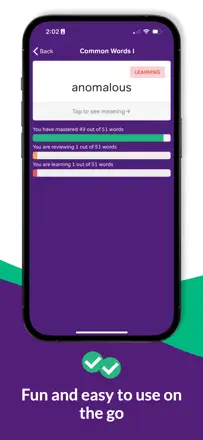
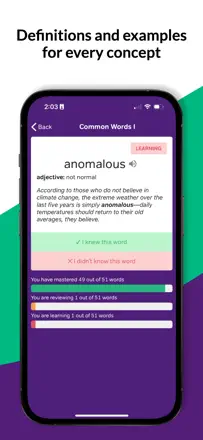
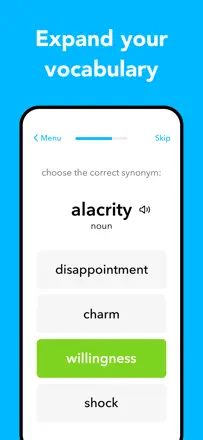
An outstanding dictionary with human, informal definitions and a smart spaced repetition system that surfaces real knowledge gaps. The app is technically outdated: long-term users report compatibility issues with newer iPhones.
Points forts : Definitions written in plain language with examples from real texts. The algorithm tracks knowledge of a word across different contexts rather than just recording that you have seen the card.
Reproches : Teaches reading comprehension and passive vocabulary, not speaking. The technical state of the app is a genuine concern for users on recent devices.
Pour qui : Advanced learners and native speakers who want to genuinely know words, not just recognize them. Writers and academics who need precise vocabulary.
Rang 58. Note des avis : 46 sur 100. Note sur l’App Store : 4,8★ · 215 322 notes
46sur 100
The app's unique strength is native-speaker video clips that lodge words in memory better than text. Community-made courses have been removed and the structure has broken down. The AI conversation partner exists but generates incorrect sentences.
Points forts : Video fragments from real native speakers for word memorization. A wide language selection including rare ones. AI dialogues for live speech practice. A clean and fast interface.
Reproches : Community courses that made Memrise distinctive have been removed. The AI generates grammatically incorrect sentences. Progress can reset unexpectedly. The paywall blocks most content.
Pour qui : Intermediate learners who want video-based vocabulary building and have already established a grammar foundation elsewhere.
Rang 59. Note des avis : 46 sur 100. Note sur l’App Store : 4,7★ · 18 598 notes
46sur 100
Structured dialogues with a microphone give real English speaking practice, but the interface is only available in 13 languages, cutting off speakers of Persian, Tamil, and many others.
Points forts : The dialogue format with listening, repetition, and system feedback is appreciated by users. Several people noted they actually started speaking after regular practice.
Reproches : Speech recognition does not handle numbers and some words even from native speakers. Content cuts off at a ceiling level with no advanced path. Interface language barriers lock out many potential users.
Pour qui : Intermediate English learners who want structured dialogue practice and can use the app in a supported interface language.
Rang 60. Note des avis : 45 sur 100. Note sur l’App Store : 4,8★ · 5 093 notes
45sur 100
An AI conversation tutor with live grammar and pronunciation correction during dialogue, a strong idea for those who specifically need to speak. Disrupted by instability, aggressive billing, and repetitive conversation topics.
Points forts : Instant grammar correction within the dialogue and the ability to practice speaking at any time without booking a real teacher.
Reproches : The AI cycles through the same topics (often steering toward food and cooking), billing is described as aggressive and opaque, and technical crashes interrupt sessions.
Pour qui : Intermediate learners who want AI-driven spoken practice at any time and are willing to tolerate some instability.
Rang 61. Note des avis : 44 sur 100. Note sur l’App Store : 4,7★ · 743 229 notes
44sur 100
More structured than Duolingo: grammar explanations and thematic blocks are present. But it does not lead to stable conversational speech since grammar is touched on superficially, lessons move fast, and progress plateaus at B1.
Points forts : Structured lessons in a classic style, grammar explanations better than most competitors. Native speaker recordings for the Danish course are noted as authentic and accurate. Thematic progressions are clear.
Reproches : Lessons progress faster than material can be absorbed. Grammar explanations are present but thin. Speaking practice is limited to phrase repetition without free dialogue.
Pour qui : Beginners who want more structure than Duolingo offers but are not yet ready for a full textbook approach.
Rang 62. Note des avis : 44 sur 100. Note sur l’App Store : 4,6★ · 6 102 notes
44sur 100
A unique learning format through chat-style messaging with typing on a Korean keyboard helps you retain Hangul and basic vocabulary better than traditional flashcards, but the app has not been updated in a long time.
Points forts : The interactive chat format with typing on a Korean keyboard demands active engagement with the language. Users say they remember words better than in other apps.
Reproches : No reliable pronunciation practice. Speech recognition is unreliable. The app has not been updated and feels dated. Content runs out before intermediate level.
Pour qui : Beginners who want an interactive approach to Hangul and basic Korean vocabulary beyond passive flashcards.
Rang 63. Note des avis : 43 sur 100. Note sur l’App Store : 4,6★ · 62 869 notes
43sur 100
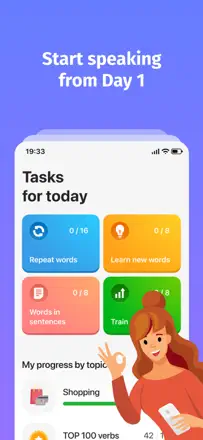
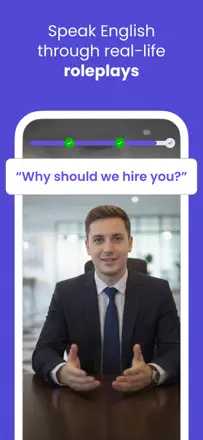
A beautiful app with a good role-play dialogue concept, but the role-play mode crashes, there is no placement test, and features shown in the promotional video are not found in the actual app.
Points forts : Role-play dialogues in real-life scenarios give practice in natural communication. Pronunciation lessons with native speaker imitation help place sounds.
Reproches : The role-play mode crashes on the second or third response. All levels are funneled into one course with no placement test. Features like shadowing that appear in promotional material are absent in the real app.
Pour qui : Intermediate learners looking for conversational role-play practice, if the technical issues get resolved.
Rang 64. Note des avis : 42 sur 100. Note sur l’App Store : 4,8★ · 157 097 notes
42sur 100
The entire format is built around live conversation with an AI tutor, which is valuable for spoken practice. But the tutor mispronounces words in German, mixes registers in Japanese, and does not understand speech in languages with unfamiliar phonetics.
Points forts : Immersive conversational format with real-life scenarios. For B2-level French this is a good space for speaking practice without the stress of a live partner.
Reproches : The AI tutor mispronounces words (German, Japanese), confuses formal and informal registers, and does not recognize speech in languages with non-Latin phonetics. Progress is not saved between sessions for some users.
Pour qui : Intermediate to advanced learners (B1 and above) in French or Spanish who want AI-driven conversational practice and can tolerate inaccuracies.
Rang 65. Note des avis : 42 sur 100. Note sur l’App Store : 4,7★ · 22 175 notes
42sur 100
An English course built around short narrative video clips: you watch a scene, then work through vocabulary and grammar from it. The method via live context is a genuine advantage. The video material is dated, which several users mention specifically. The course spans A1 to B2 and includes certificates on level completion.
Points forts : Video lessons with real actors provide a model of natural speech in context, not voiced illustrations but actual mini-scenes. Several users note they completed the program and felt confident in real conversations.
Reproches : No free dialogue or independent speaking output: exercises are multiple-choice and repetition-based. Video content is years old, which reduces engagement for some users. No pronunciation feedback from the system.
Pour qui : Beginner to intermediate learners who prefer learning English through story and visual context rather than drills and grammar rules.
Rang 66. Note des avis : 42 sur 100. Note sur l’App Store : 4,6★ · 11 498 notes
42sur 100
A simple vocabulary trainer with pictures and audio for absolute beginners. All content is covered in a single session. Does not teach speaking and does not explain grammar.
Points forts : Pictures paired with audio without romanization on tests correctly conditions you to perceive the language directly. The pace is calm and suitable for children. No intrusive ads.
Reproches : Content is exhausted in one session. No grammar, speaking practice, or systematic introduction to the writing system. The app does not lead anywhere after the initial vocabulary.
Pour qui : Young children or absolute beginners who want a first gentle exposure to basic Japanese vocabulary with pictures and sound.
Rang 67. Note des avis : 41 sur 100. Note sur l’App Store : 4,7★ · 7 563 notes
41sur 100
Dynamic daily lessons with audio and a chatbot give an initial push, especially for beginners. However, level tracking is inadequate, the chatbot simulates dialogue more than it teaches real speech, and microphone recognition is unreliable.
Points forts : Varied exercise formats, native audio, and a day-by-day structure with a visible streak. Users say the app motivates them to practice daily.
Reproches : Does not lead to real speech: the chatbot repeats scripted responses rather than holding a genuine conversation. Microphone recognition is inconsistent. No grammar explanations.
Pour qui : Beginners looking for daily structure and motivation to build a consistent habit, paired with a more substantive course.
Rang 68. Note des avis : 40 sur 100. Note sur l’App Store : 4,7★ · 71 261 notes
40sur 100
The best mobile tool for memorizing vocabulary through pictures, not for speech. Fast visual association sessions lock words in well. No grammar at all, no speaking practice, and not enough depth to reach free conversation.
Points forts : Visual word association without translation to the native language. Fast five-minute sessions. Rare languages (Tagalog, Icelandic, Ukrainian). A simple uncluttered interface.
Reproches : Teaches only word recognition, not language use. No grammar or listening practice in a communicative context. After weeks of use you know words but cannot build sentences.
Pour qui : Beginners who want a fast visual vocabulary starter before moving to a course with grammar and speaking.
Rang 69. Note des avis : 39 sur 100. Note sur l’App Store : 4,5★ · 4 700 notes
39sur 100
An AI conversation partner with instant pronunciation feedback, a workable idea for those who feel embarrassed speaking with people. However, the AI loops, grammar errors in the content undermine trust, and speech recognition is unreliable.
Points forts : Talking to an AI without judgment helps overcome the fear of speaking. Users with language anxiety report becoming bolder in real conversations.
Reproches : The AI repeats the same questions in a loop and does not respond to user input that deviates from its script. Grammar errors appear in the app's own text. Speech recognition is inconsistent.
Pour qui : Learners with speaking anxiety who want a pressure-free environment to practice output before attempting real conversations.
Rang 70. Note des avis : 38 sur 100. Note sur l’App Store : 4,7★ · 5 273 821 notes
38sur 100
An outstanding tool for sustaining interest at the start, but not for real speech. It teaches word recognition in exercises rather than live speaking. Long-term users write directly: thousands of words collected and still cannot hold a conversation.
Points forts : Wide language selection including rare ones (Hawaiian). The game format keeps beginners engaged. Several users report saying short Spanish phrases after two weeks.
Reproches : Grammar explanations have been removed. Free speaking is not practiced. The hearts and streaks mechanic optimizes for daily engagement rather than actual learning. Progress stalls at basic phrases.
Pour qui : Complete beginners who want a fun, low-friction way to start a language and build the habit, paired with a substantive course for real progress.
Rang 71. Note des avis : 38 sur 100. Note sur l’App Store : 4,7★ · 7 569 notes
38sur 100
A wide language selection including rare ones, plus pronunciation flashcards and step-by-step vocabulary repetition. Weak for speaking: no conversational practice, no grammar explanations, and no level adaptation. For some languages pronunciation quality is below acceptable.
Points forts : Coverage of rare languages (Tagalog, Kazakh, Estonian, Bosnian) and structured word repetition with contextual categories. The only place to study a language not available on Duolingo.
Reproches : No speaking practice, grammar, or level adaptation. Pronunciation quality varies significantly by language. No contextual sentences, only isolated words.
Pour qui : Learners of rare languages who have no other structured mobile option and need a starting vocabulary base.
Rang 72. Note des avis : 35 sur 100. Note sur l’App Store : 4,7★ · 192 238 notes
35sur 100
An interesting concept: language learning through film clips and book excerpts. But reviews about course quality show limited content, stalled progress, and errors in French lessons. Reputation is damaged by systematic complaints about unauthorized charges.
Points forts : Learning through authentic film and literature fragments. For advanced Spanish users this is a valuable immersion format into native conversational speech.
Reproches : French lessons stop at A2. Progress stalls without explanation. Unauthorized charges are reported by multiple users independently, which overshadows content concerns.
Pour qui : Advanced Spanish learners who want immersion through authentic media and can look past the billing reputation.
Rang 73. Note des avis : 35 sur 100. Note sur l’App Store : 4,6★ · 28 219 notes
35sur 100
A definitive English dictionary with precise definitions, synonyms, and historical usage examples. High value as an English reference tool, but not a language learning instrument: no exercises, no guidance for learners, and no level adaptation.
Points forts : Definitions more accurate and richer than any other mobile dictionary: nuances of meaning, historical context, and literary examples. Indispensable for working with academic English subtleties.
Reproches : Not a language learning tool: no exercises, no level structure, no pronunciation practice. Foreign language learners will not benefit. Some specialized words are missing.
Pour qui : Native English speakers and advanced users doing serious academic or professional writing who need a precise authoritative reference.
Rang 74. Note des avis : 35 sur 100. Note sur l’App Store : 4,7★ · 6 054 notes
35sur 100
A reliable offline German-English translator with contextual sentence examples and noun gender indicators. Useful for tourists and those living in German-speaking countries, but it does not teach the language.
Points forts : Contextual sentence examples for each word with noun gender and usage variants help clarify the difference between similar constructions. Works without an internet connection.
Reproches : Does not teach language: no structured lessons, grammar, or pronunciation in a learning context. A reference tool only. Some specialized vocabulary is absent.
Pour qui : Tourists, expats, and business travelers in German-speaking countries who need a reliable offline dictionary and quick translations.
Rang 75. Note des avis : 34 sur 100. Note sur l’App Store : 4,6★ · 12 112 notes
34sur 100
The app takes the right idea, conversational practice with AI, but speech recognition is unreliable: it corrects even native speakers and gets stuck on the same two words repeatedly. One language at a time, and switching languages resets all progress. Some supported languages perform poorly (Arabic, Japanese kanji read with Chinese pronunciation).
Points forts : Users praise the wide range of conversation topics, slow and clear AI speech synthesis, and the fact that this was the first app to give them a real feeling of live conversation.
Reproches : Speech recognition rejects correct input even from native speakers. Switching languages loses all progress. Arabic and Japanese have significant quality issues. Sessions end abruptly without explanation.
Pour qui : Beginner to intermediate learners who want AI conversational practice in a major language and can tolerate technical rough edges.
Rang 76. Note des avis : 34 sur 100. Note sur l’App Store : 4,5★ · 3 837 notes
34sur 100
A simple audio player with vocabulary and phrases for tourists and absolute beginners. Works as background learning during a car ride. Does not provide grammar, pronunciation feedback, or speaking practice.
Points forts : Automatic playback of vocabulary and phrases with translation lets you learn passively. Several users report being able to get their point across during travel after a few hours of listening.
Reproches : Teaches phrases by rote rather than how to construct speech. No interaction, no feedback, no progression beyond basic phrases. Passive listening alone does not produce active language.
Pour qui : Tourists who need survival phrases in a language before a trip and want a passive audio option during commutes.
Rang 77. Note des avis : 32 sur 100. Note sur l’App Store : 4,7★ · 27 010 notes
32sur 100
A flashcard app for memorizing English vocabulary through spaced repetition. The mechanic works, but the word list raises questions: several users flag words that are extremely rare in real speech. Speaking, grammar, and listening comprehension are not covered, only passive word recognition.
Points forts : The repetition algorithm helps retain words: users report memorizing around 300 words in 25 days and starting to understand call-center English or news broadcasts better.
Reproches : The word selection includes low-frequency words that rarely appear in everyday speech. No grammar or speaking practice. Passive recognition only, no active production.
Pour qui : Learners at A2 and above who want to systematically grow their passive English vocabulary and track daily retention.
Rang 78. Note des avis : 32 sur 100. Note sur l’App Store : 4,8★ · 17 537 notes
32sur 100
An AI tutor that corrects pronunciation and pinpoints specific errors, but speech access is blocked after just a few seconds of dialogue, and the Japanese AI speaks with an American accent using only romanization.
Points forts : Users who reached actual content praise targeted pronunciation correction with the exact location of the error identified. The lesson structure for new vocabulary is clear and sequential.
Reproches : Speech access is blocked almost immediately and does not allow a complete utterance. The Japanese AI uses only romanization and speaks with an American accent, undermining authenticity. Progress resets between sessions for some users.
Pour qui : Beginners in Spanish or French who want pronunciation correction from the very start, if they can get past the access barriers.
Rang 79. Note des avis : 32 sur 100. Note sur l’App Store : 4,6★ · 4 862 notes
32sur 100
An immersive approach for children through pictures and phonetics can build an initial vocabulary. However, the app is designed for Spanish-speaking families: the interface is entirely in Spanish, which disorients English-speaking children without a Spanish-speaking parent present.
Points forts : Game-based picture cards with native audio appeal to children ages 4 to 6. Bilingual parents note good pronunciation and varied topics.
Reproches : Not suitable for learning from scratch without a native speaker present: the Spanish-only interface confuses non-Spanish-speaking parents. No grammar or structured progression beyond basic vocabulary.
Pour qui : Spanish-speaking families with young children who want a playful vocabulary reinforcement tool at home.
Rang 80. Note des avis : 30 sur 100. Note sur l’App Store : 4,8★ · 205 606 notes
30sur 100
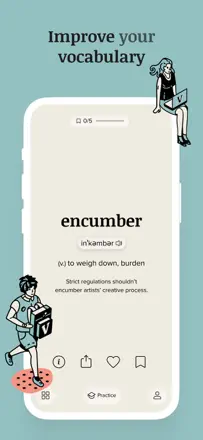
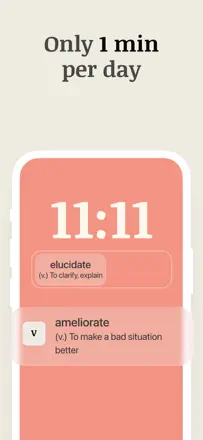
A daily-word widget works reliably and passively expands your lexicon, but as a learning tool it falls short: without exercises to reinforce retention, and with some inaccurate definitions.
Points forts : A lock screen widget with a daily word and etymology provides constant passive exposure to new vocabulary without any effort. Sentence examples help clarify usage.
Reproches : Without exercises to practice the words, new vocabulary does not stick. Some definitions are inaccurate. One word per day is too slow for meaningful vocabulary growth.
Pour qui : Those who enjoy discovering new words passively and want a low-effort daily vocabulary habit as a supplement to other study.
Rang 81. Note des avis : 30 sur 100. Note sur l’App Store : 4,7★ · 38 465 notes
30sur 100
A vocabulary app built around a daily word with illustration and contextual examples. The concept worked well until the 2024 update: the art illustrations were removed, streaks were wiped, and saved words disappeared. The linguistic quality of word selection is high, but one word a day is too slow for meaningful vocabulary growth.
Points forts : Rare and precise words for writing and journalism: the app selects vocabulary that genuinely enriches expression. Pre-update art illustrations are fondly remembered by long-term users.
Reproches : The 2024 update broke streaks, removed saved words, and replaced original illustrations with generic images. Core features users relied on were changed without notice. One word per day is insufficient for systematic vocabulary building.
Pour qui : Writers, journalists, and advanced English users who want daily exposure to precise, high-value vocabulary as a supplement to their reading.
Rang 82. Note des avis : 28 sur 100. Note sur l’App Store : 4,8★ · 110 405 notes
28sur 100
Was an interesting tool for pronunciation training with phoneme-level analysis. After a major update the interface was completely redesigned, pronunciation features were buried behind an AI avatar, and voice recognition became unreliable. The app is slow and frequently freezes.
Points forts : Detailed phoneme-level pronunciation breakdown. A large topic library. In the old version there was a clear progression through specific English sounds (TH, SH, AE).
Reproches : Speech recognition does not catch correct pronunciation and marks it wrong. The AI avatar layer obscures the pronunciation tools that made the app useful. Frequent freezes and slow performance.
Pour qui : Pronunciation-focused English learners who were using the old version. The new version is hard to recommend until stability improves.
Rang 83. Note des avis : 28 sur 100. Note sur l’App Store : 4,7★ · 19 906 notes
28sur 100
A flashcard tool that deliberately mimics the AnkiMobile name. The repetition algorithm is weaker than the original, the interface has degraded through a series of updates, and sync is unreliable. Works as a wrapper for your own decks but contains nothing language-specific.
Points forts : Users who figured it out appreciate folder-based deck organization, support for images and audio in cards, and multi-device functionality.
Reproches : Weaker SRS algorithm than AnkiMobile. Interface has degraded over updates. Sync is unreliable across devices. No language-specific content or built-in vocabulary.
Pour qui : Those who want a free Anki-like SRS tool and already have their own decks or know where to find pre-made ones.
Rang 84. Note des avis : 28 sur 100. Note sur l’App Store : 4,7★ · 6 674 notes
28sur 100
A children's English course through pictures and simple phrases. Due to a technical bug (a dog appearing at the end of every lesson for a month) progress is not tracked. Audience is preschool-age children and there is no real data on learning outcomes in reviews.
Points forts : Bright visual design and simple interactive tasks appeal to children. Parents from Spanish-speaking countries note that the child willingly reopens the app.
Reproches : Does not show whether the child will learn to speak: no pronunciation feedback, no structured progression beyond basic words. The persistent bug blocked progress tracking for an extended period.
Pour qui : Parents of preschool-age children who want a visually appealing English exposure tool for young children with no prior English.
Rang 85. Note des avis : 22 sur 100. Note sur l’App Store : 4,6★ · 43 157 notes
22sur 100
A language exchange platform with native speakers where correction tools and dialect filtering are useful, but finding a partner focused on actual study rather than socializing is rare.
Points forts : Country and level filters help find the right dialect. Built-in message translation works directly in the chat without switching apps. Voice rooms provide live speaking practice.
Reproches : Most incoming contacts turn into flirting or spam. Finding a study-focused partner is rare and time-consuming. The app facilitates contact but does not structure learning.
Pour qui : Intermediate and above learners who want conversational practice with native speakers and are willing to filter out non-study contacts patiently.
Rang 86. Note des avis : 22 sur 100. Note sur l’App Store : 4,7★ · 10 034 notes
22sur 100
A platform with live native-speaker teachers and grammar progression by level that in theory allows you to reach conversational fluency, but all levels are mixed in the same classes so beginners end up with advanced learners.
Points forts : Live sessions with native speakers available around the clock, a clear grammar progression by level, and immediate teacher feedback during class.
Reproches : Promises fluency in a year but most who complete the course do not reach it. Mixed-level classes mean beginners are grouped with advanced learners. Support response times are slow.
Pour qui : Motivated learners willing to pay for live instruction who understand that the timeline promises are optimistic.
Rang 87. Note des avis : 22 sur 100. Note sur l’App Store : 4,6★ · 7 644 notes
22sur 100
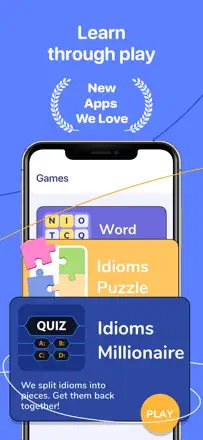
A gamified idiom review format will appeal to those who already know the basics and want variety, but it is useless for beginners, audio is synthetic, and the content library runs out within a few sessions.
Points forts : The gamified card format appeals to those who want to review familiar idioms in a fun way without reading a textbook.
Reproches : Idioms presented without context. No native-speaker pronunciation. Grammar is completely absent. Content is exhausted within a few sessions with no path forward.
Pour qui : Intermediate and above learners who want a light, playful way to review English idioms they already know roughly.
Rang 88. Note des avis : 18 sur 100. Note sur l’App Store : 4,6★ · 37 365 notes
18sur 100
A language exchange platform with native speakers where built-in in-chat translation is convenient, but reaching actual live conversation is increasingly difficult due to a verification process that can take up to 47 days.
Points forts : Built-in message translation directly in the chat sets Tandem apart from competitors and lets you look up words without leaving the conversation. The user base is diverse in language and geography.
Reproches : The platform connects people but does not teach language. Most contacts turn out to be spammers or people with non-study intentions. The verification wait is too long.
Pour qui : Intermediate and above learners with patience for filtering contacts who want genuine conversational exchange with native speakers.
Rang 89. Note des avis : 18 sur 100. Note sur l’App Store : 4,6★ · 13 415 notes
18sur 100
An AI conversation trainer with role-play scenarios. The idea is right: practicing speech through thematic dialogues. The execution is poor: voice models are low quality, role-play sessions break and swap lines between characters, and audio is unclear. The company's billing policy is described as aggressive and dishonest.
Points forts : A few users noted the right concept: thematic conversations beat memorizing phrases. One of the few tools where you respond to a scenario rather than fill in a blank.
Reproches : Voice model quality is poor. Role-play sessions crash and characters swap lines. Audio is unclear. Billing described as aggressive by multiple users independently.
Pour qui : Would suit intermediate learners wanting AI role-play practice if the technical and billing issues were resolved.
Rang 90. Note des avis : 18 sur 100. Note sur l’App Store : 4,5★ · 9 696 notes
18sur 100
The concept of an AI conversation tutor works, but the execution is unreliable: constant drop-outs, AI accent that does not match the target language, and progress that does not save. Amid widespread complaints about unauthorized billing the substantive problems fade into the background.
Points forts : The live conversation format with pronunciation correction appeals to the few users who have no technical problems. Several users noted progress in French and Spanish comprehension.
Reproches : Constant session drop-outs. AI accent does not match the target language. Progress fails to save. Billing complaints are widespread and independent.
Pour qui : Those willing to navigate significant technical instability for AI-driven conversational practice in French or Spanish.
Rang 91. Note des avis : 18 sur 100. Note sur l’App Store : 4,6★ · 5 873 notes
18sur 100
An AI tutor with the idea of daily conversational practice without a schedule, but the microphone frequently fails to register answers and pronunciation correction is unreliable.
Points forts : The idea of a daily 15-minute speaking session with an AI at any time appeals to those who managed to reach real content and start a dialogue.
Reproches : The microphone frequently fails to register responses and the dialogue breaks down. Pronunciation correction is inconsistent and misses errors. Language selection is limited. Progress does not save reliably.
Pour qui : Intermediate learners who want flexible daily AI conversation practice and can tolerate significant technical friction.
Rang 92. Note des avis : 15 sur 100. Note sur l’App Store : 4,5★ · 9 460 notes
15sur 100
The app positions itself as a voice translator rather than a language learning tool. Basic translation works, but advertised features (movie subtitle translation) are absent. It builds no language skills whatsoever.
Points forts : Basic text translation quality is described as acceptable. The interface is simple.
Reproches : Does not teach language at all: no content, no lessons, no feedback. A translator, not an educational tool. Voice packs for some languages are incorrect.
Pour qui : Those who need basic translation and are not looking for language learning.
Rang 93. Note des avis : 14 sur 100. Note sur l’App Store : 4,8★ · 327 851 notes
14sur 100
A dictionary that was the gold standard for years lost its core value after a change of ownership: saved word collections were deleted without warning, definition navigation is broken, and search returns wrong entries.
Points forts : The thesaurus and related definitions in one place used to let you move from word to word through chains of meaning, which made it an indispensable deep vocabulary tool for years.
Reproches : Personal word collections that users built over years were deleted without notice. Definition navigation is broken. Search sometimes leads to the wrong entry. Core features that defined the product no longer work.
Pour qui : Formerly for serious English vocabulary study and writing. Currently the product's reliability is too low to recommend.
Rang 94. Note des avis : 14 sur 100. Note sur l’App Store : 4,6★ · 18 050 notes
14sur 100
An AI chat for spoken English practice that reduces anxiety before live conversation, but the content does not match what is shown in promotional videos, speech recognition is unreliable, and you cannot change the language being studied.
Points forts : Dialogue with an AI tutor reduces anxiety for beginners before live interaction. Learning through songs and conversational examples worked for those who reached it.
Reproches : Speech recognition is acknowledged as weak even by users satisfied with the app overall. Advertised features are absent. Cannot switch the study language. Session quality is inconsistent.
Pour qui : Anxiety-prone beginners who want a low-pressure AI partner for English speaking practice before attempting live conversations.
Rang 95. Note des avis : 8 sur 100. Note sur l’App Store : 4,7★ · 12 261 notes
8sur 100
Advertised content such as audiobooks and film subtitles is absent from the app. No grammar explanations and no speaking practice. The app teaches only vocabulary through flashcards.
Points forts : A few users who reached the app without technical issues noted a convenient interface for word learning and realistic dialogue examples in certain lessons.
Reproches : Content does not match what promotional materials promised. Core advertised features are absent. Speaking practice and grammar are entirely missing. Technical issues block many users from reaching even the available content.
Pour qui : Those who only need basic vocabulary flashcards and are not misled by the broader feature promises in marketing.
À propos des chiffres
Deux chiffres — deux sources
Elles aident à comparer les apps, mais ne remplacent pas la vérification de ta propre tâche.
Score des avis · jusqu’à 100
Le score conservé de l’étude inApp sur les textes des avis. Il évalue l’ensemble de l’app dans l’archive, pas la fiabilité d’une fonction précise.
Note de la boutique · jusqu’à 5
La note de la page de l’app au moment de la collecte. La note et la version actuelles peuvent différer.
Dans l’échantillon archivé de ce sujet : 95 apps et 39 743 avis lus. C’est le volume total de l’étude, pas le nombre d’avis par app.
Un écart entre les chiffres ne prouve pas de manipulation. La date de calcul et la méthode complète du score ne sont pas dans l’archive mobile. Compare les descriptions des tâches et les citations sources, et vérifie les conditions dans la version actuelle.