Reviews of Obsidian and Bear describe trouble editing and syncing on the phone. Test a short correction to a note and the resolution of a conflict between devices.
Quelles apps les gens utilisent
Ces apps sont mentionnées dans le décryptage de cette tâche. Ouvre chacune pour comparer les points forts et les limites. L’ordre de la liste n’est pas un classement d’adéquation.
Rang 1. Note des avis : 85 sur 100. Note sur l’App Store : 4,6★ · 388 notes
85sur 100
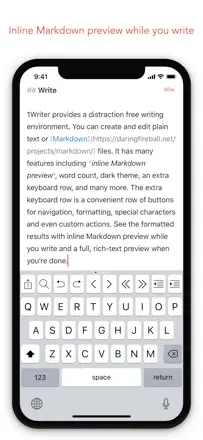
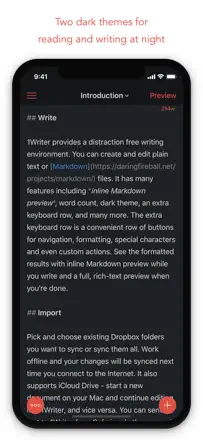
A clean, reliable Markdown editor with Dropbox and iCloud support, an extended keyboard, and an actions system. Used for years as a trusted mobile node in personal knowledge management setups. Rarely breaks, sync just works.
Points forts : Lightning-fast full-text search across all Dropbox files. The extended keyboard with Markdown buttons speeds up typing.
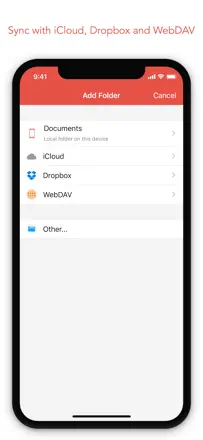
Reproches : No OneDrive or Google Drive support: only Dropbox and iCloud. A custom iCloud folder is not directly accessible by default. Updates are rare, though the stability compensates for it.
Pour qui : Developers, researchers, and technical writers building a plain-text knowledge base synced via Dropbox or iCloud.
Rang 20. Note des avis : 68 sur 100. Note sur l’App Store : 4,5★ · 2 581 notes
68sur 100
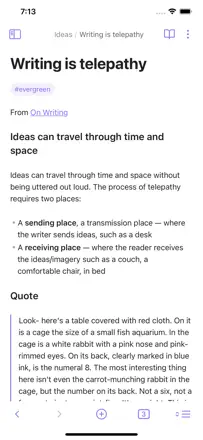
A powerful linked-note system in Markdown format with files stored on-device. The desktop version is strong. The mobile version falls short: text input is awkward, the cursor jumps, and iCloud sync is unreliable.
Points forts : Full ownership of data as plain text files. A graph of connections between notes for navigating the knowledge base. A massive plugin ecosystem. Works offline.
Reproches : Mobile text input is uncomfortable: the cursor jumps during manual editing and the toolbar disappears. iCloud sync causes a black screen and missing vaults for some users. High barrier to entry: the app is not for anyone unfamiliar with Markdown.
Pour qui : Researchers, programmers, and writers building a long-term knowledge base on desktop who use the phone only for reading and quick edits.
Rang 11. Note des avis : 74 sur 100. Note sur l’App Store : 4,7★ · 6 836 notes
74sur 100
The best plain-text Markdown note-taking tool in the sample. Opens instantly, and the tag system replaces folders while working more flexibly. iCloud sync is reliable. Bear 2.0 removed the convenient toolbar, worsening the iPhone experience.
Points forts : The tag system lets you find a note across multiple intersecting topics without creating folders. Works equally fast on iPhone and Mac, and iCloud sync requires no separate account. Markdown renders beautifully without getting in the way while typing.
Reproches : Bear 2.0 removed the compact toolbar: formatting is now awkward on a small screen. Search does not support advanced filters and is slow in large archives. Attachments and PDFs are not supported without the premium subscription.
Pour qui : Writers, developers, and researchers who need a fast Markdown editor with reliable sync across the Apple ecosystem.
Rang 15. Note des avis : 72 sur 100. Note sur l’App Store : 4,7★ · 1 053 notes
72sur 100
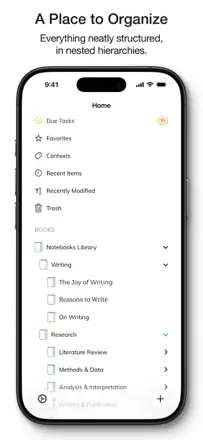
A deep organizer with nested folders, Markdown support, WebDAV and Dropbox sync, and multi-format export. A longtime favorite for those who want to own their data without a forced cloud subscription.
Points forts : Reliable sync via WebDAV and Dropbox, unlimited folder hierarchy, and stable operation over many years. Does not break during updates.
Reproches : Dropbox dependency limits users with three or more devices. Some features (drawing, Fountain) are advertised but work unreliably. Migrating from older versions of the app caused document loss for some users.
Pour qui : Writers and researchers who need a long-term, reliable knowledge base with a folder structure and no cloud subscription.
Rang 7. Note des avis : 78 sur 100. Note sur l’App Store : 4,8★ · 10 610 notes
78sur 100
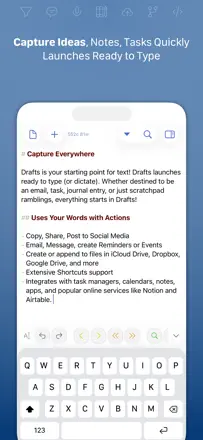
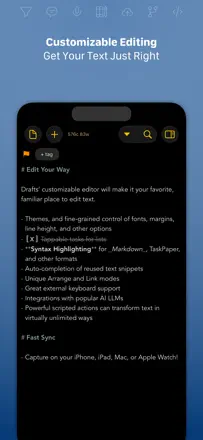
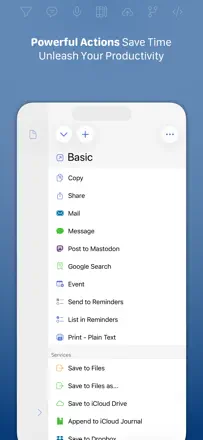
The best app for instant thought capture with routing to wherever it needs to go. Opens straight to a blank page, runs instantly, and supports scripts and integrations with dozens of services. A tool for people who already know what they want to automate.
Points forts : Opens instantly to empty text with no extra taps before you start typing. Actions let you send text to Obsidian, Slack, OmniFocus, or any other service with one tap. Dictation via Apple Watch works reliably.
Reproches : High learning curve: without reading the documentation, most of the app's capabilities stay hidden. Voice input from the iPhone keyboard sometimes stops after a few words. Advanced automation features are only available in the extended version.
Pour qui : Developers, journalists, and power users who need fast capture with automatic routing to other systems.