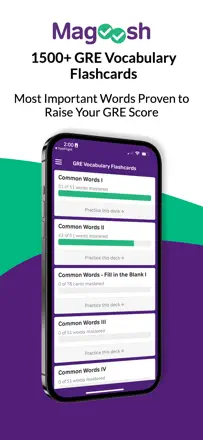
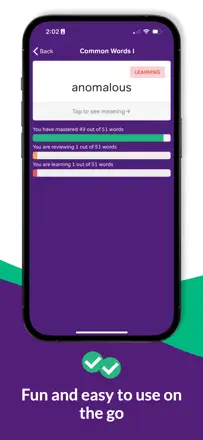
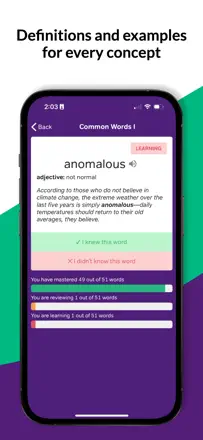
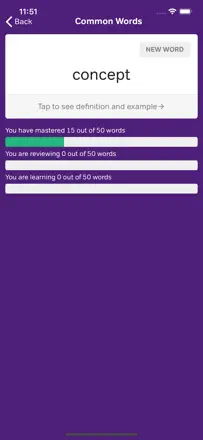
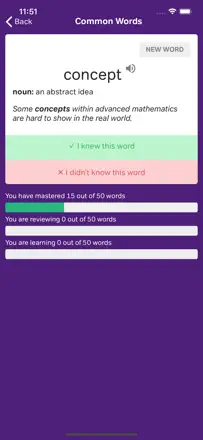
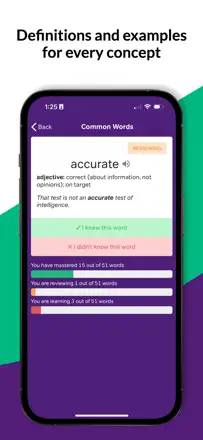
A free GRE vocabulary deck from Magoosh with curated word lists. A review algorithm exists but has real flaws: it introduces new words before older ones are solidified, occasionally resets progress, and doesn't let you manually move a word from 'Mastered' back to 'Learning'. Content quality is solid good vocab coverage and mostly good example sentences, with some weak ones.
評価点:Completely free with no ads, solid GRE word selection, clean and simple interface, and useful for non-GRE learners wanting to expand their vocabulary.
不満点:The algorithm adds new words before current ones are locked in, progress resets periodically, word statuses can't be edited, there's no full card list view, and Magoosh blog notifications are annoying.
向いている人:GRE preppers who need a free, ad-free academic vocabulary trainer. Good for passive review, weak for actively managing progress.
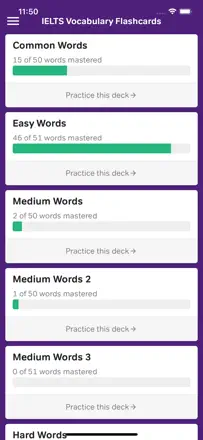
Flashcards with a fixed IELTS vocabulary set of roughly 600 words. Cards are organized by topic area with translations into other languages. The main limitation is that you can't add your own words or shuffle all categories at once. Useful as a supplement to IELTS prep but doesn't cover the full vocabulary range needed.
評価点:Cards are organized by IELTS topic blocks, allowing targeted work on weak areas.
不満点:The word base is closed and small you can't add words from your own sources or from real IELTS passages.
向いている人:IELTS preppers who want a compact core vocabulary reference on their phone as part of a broader study plan.
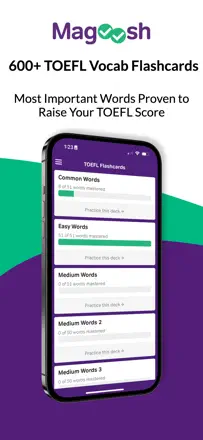
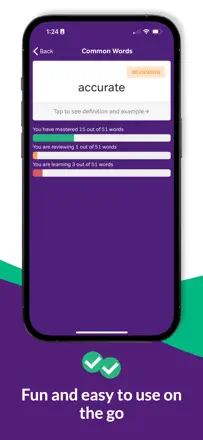
TOEFL Flashcards from Magoosh. Cards are split by difficulty level with audio and example sentences. The product is functional but narrowly focused: vocabulary only, no practice for other TOEFL sections. Progress occasionally resets. Cards are fixed no way to add your own.
評価点:Difficulty-level splits let you start at the right level and move forward without wading through things you already know.
不満点:The word set is fixed you can't add words from real TOEFL passages or create personal sets.
向いている人:TOEFL preppers who want a structured vocabulary trainer as part of their preparation, not a full course.
Brainscape is one of the few apps in this batch that genuinely implements spaced repetition with user-rated confidence. The method works, and the interface is cleaner than most competitors. The main limitations are around session control and text-to-speech.
評価点:A five-point confidence scale on every card directly drives review frequency this is honest SRS. Cross-platform: easy to create decks in the browser, easy to study on your phone.
不満点:You can't set a fixed number of cards per session. No text-to-speech. The algorithm sometimes resurfaces cards you just reviewed while ignoring ones you haven't answered.
向いている人:Students and self-learners with ready-made card sets or who want to build their own. Especially good for people who study on both phone and computer.
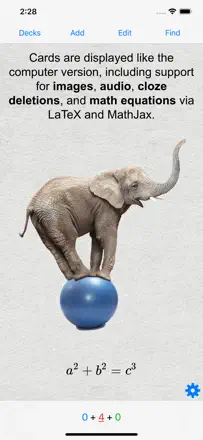
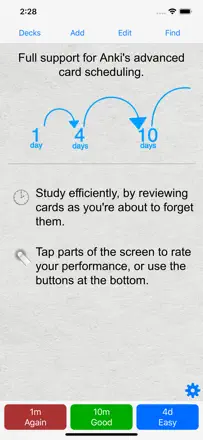
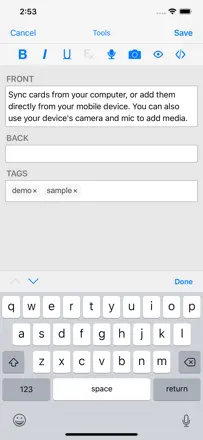
AnkiMobile Flashcards is the mobile port of the legendary Anki SRS engine. The spaced-repetition algorithm is the best in the category: configurable retention, FSRS, proven over decades. It supports media cards, import/export via AnkiWeb, and thousands of community decks. The one significant weakness is the interface it feels archaic, doesn't follow iOS conventions, and has a steep learning curve. Complex card editing is desktop-only. One-time purchase of $25.
評価点:FSRS with configurable retention delivers a science-backed review schedule. Sync through AnkiWeb. Thousands of community decks for languages, medicine, law, and more.
不満点:The interface doesn't follow iOS patterns and still feels like a web wrapper. Complex card editing is only available on desktop. There's no obvious button to study an entire deck.
向いている人:Med students, linguists, law students, and anyone serious about long-term retention who is willing to spend an hour on setup to get the best algorithm available.