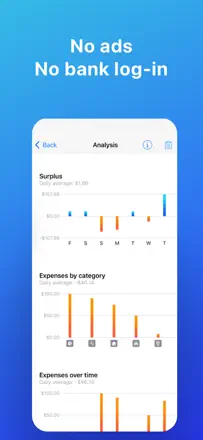
Reviews from this group value a balance that is clear and a small amount of daily work. A game, simple entry and setting money aside automatically are different forms of support, not mutually exclusive rules for everyone.
Quelles apps les gens utilisent
Ces apps sont mentionnées dans le décryptage de cette tâche. Ouvre chacune pour comparer les points forts et les limites. L’ordre de la liste n’est pas un classement d’adéquation.
Rang 2. Note des avis : 82 sur 100. Note sur l’App Store : 4,7★ · 4 841 notes
82sur 100
A minimalist daily budget planner: you enter income, fixed expenses, and a savings goal, and the app divides the remainder across the days of the month, showing how much you can spend today. No bank connection required. Radically simple, but that is exactly why most users finally stick to a budget after years of failing with other apps.
Points forts : The live 'available today' figure changes spending psychology: not 'how much is left this month' but 'how much do I have right now.' Users with ADHD and financial anxiety specifically highlight this mechanic.
Reproches : No balance forecast for future dates. Variable income (freelance, shift work) fits the model poorly. No balance carryover between months.
Pour qui : People with a fixed income who tend to spend everything at the start of the month and want a simple guide for 'how much can I spend today.'
Rang 3. Note des avis : 81 sur 100. Note sur l’App Store : 4,8★ · 554 notes
81sur 100
A daily-balance budgeter: enter your income and fixed expenses, and the app splits the free money across days to show how much you can spend today. Works especially well for people prone to impulse spending.
Points forts : A single 'how much is left today' figure gives instant clarity on your financial state. Multi-budget support. Apple Watch widget. One-time purchase.
Reproches : Recent updates broke the savings-goal logic. No data import from other apps. Initial setup takes considerable effort.
Pour qui : Anyone who wants to stay within a monthly budget without dealing with categories, especially people prone to impulse spending or those with attention-deficit disorder who need one simple number.
Rang 11. Note des avis : 76 sur 100. Note sur l’App Store : 4,8★ · 1 810 notes
76sur 100
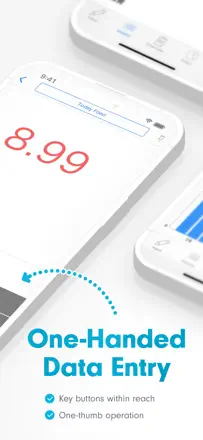
An extremely simple manual tracker: add a line item, enter an amount, check the balance. No bank sync, no automation: only what you enter yourself. This makes it a reliable mindfulness tool for people with irregular income.
Points forts : One screen, ten seconds per entry. Complete freedom to create categories for any scenario. No forced bank link: data stays on the device.
Reproches : No balance forecast or scheduled transactions. The free version limits the number of records. No cross-device sync.
Pour qui : People with irregular income, students, and those who want to keep a manual cash log without any bank connections.
Rang 51. Note des avis : 51 sur 100. Note sur l’App Store : 4,8★ · 85 741 notes
51sur 100
Qapital does one thing well: it turns trigger rules into automatic savings (round-up to the dollar, the 52-week rule, a percentage of income). Spending awareness is a side effect, not the primary function. When the mechanism works, users save effortlessly. When bank sync breaks or a withdrawal is blocked, support is essentially absent.
Points forts : Flexible trigger rules for auto-saving: rounding up purchases, a percentage of incoming funds, a fixed weekly contribution. Visual savings goals with progress bars motivate continued saving.
Reproches : Bank sync breaks without warning and rules stop firing. Savings stall without the user noticing. Withdrawing saved funds takes significantly longer than advertised and is sometimes blocked without explanation. Closing an account through the app does not work. Support responds slowly.
Pour qui : People who need automated savings by rules rather than a manual budget. Those willing to keep some money in the app on a short time horizon.