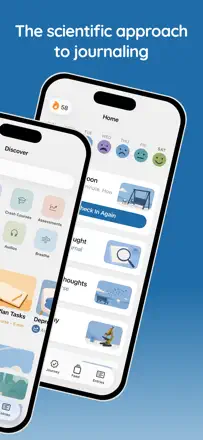
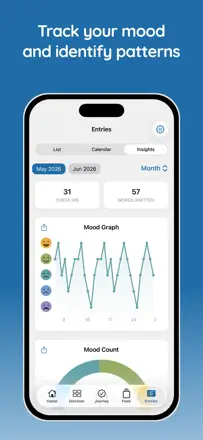
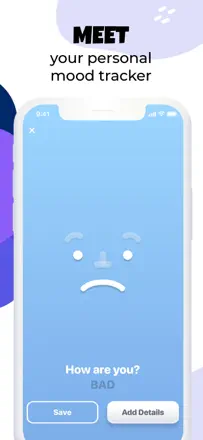
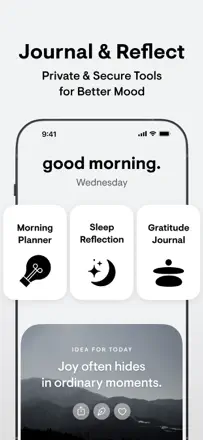
Write down the situation causing the anxiety and their own thoughts, so as to come back to them at a calmer moment or discuss them with a professional.
These apps are mentioned in the breakdown of this job. Open each one to compare strengths and limits. The order of the list is not a ranking of fitness.
Rank 29. Review score: 60 out of 100. App Store rating: 4.8★ · 29,127 ratings
60of 100
The CBT structure helps identify cognitive distortions, and therapists actively recommended the app to clients. After a redesign, features began conflicting with each other, the AI chat responds with platitudes, and it occasionally switches to the wrong language.
Praised: The step-by-step CBT thought breakdown gives real insights into your own patterns.
Complaints: Being forced to choose a streak length before writing feels like pressure rather than support.
Best for: Those dealing with anxiety who want structured CBT self-help
Rank 1. Review score: 78 out of 100. App Store rating: 4.9★ · 28,563 ratings
78of 100
A rich emotion vocabulary with a two-axis scale genuinely helps people name what they are feeling. The free, no-subscription model sets it apart, and therapists actively recommend it to their clients.
Praised: A detailed emotion map split by energy and valence lets you describe your state with real precision.
Complaints: The friend-sharing and sync features are unreliable, and that is the app's core social function.
Best for: Those who want to understand their emotions better without paying a subscription
Rank 37. Review score: 56 out of 100. App Store rating: 4.7★ · 10,964 ratings
56of 100
One of the few mood trackers with a real CBT mechanic: you identify a cognitive trap and challenge it. It works as a therapy supplement, but widgets have been broken for over a year and period progress is only visible in the paid version.
Praised: The step-by-step thought breakdown through cognitive traps helps where simply rating your mood does not.
Complaints: Widgets have been broken for over a year; mood analytics for a given period is locked behind a paywall.
Best for: Those who have done or are doing CBT therapy and want to practice the techniques on their own
Rank 15. Review score: 65 out of 100. App Store rating: 4.8★ · 34,852 ratings
65of 100
Stoic philosophy fits the daily reflection format well, and the free-writing space is valued by long-time users. Prompts repeat, AI feedback is shallow, and cross-device sync is unreliable.
Praised: The minimal design and the idea of writing without judgment help people regularly express their thoughts.
Complaints: Prompts loop quickly and stop being surprising.
Best for: Those looking for a daily self-observation practice in the spirit of stoicism
Rank 24. Review score: 62 out of 100. App Store rating: 4.9★ · 3,118 ratings
62of 100
The AI conversation partner genuinely helps formulate thoughts and deepen reflection, but users with intensive use quickly hit message limits and response quality is inconsistent.
Praised: The conversational format helps you get thoughts out and structure them without fear of judgment.
Complaints: The AI occasionally mixes up facts from past entries and tends toward excessively enthusiastic reactions to any event.
Best for: People who need an accessible conversation partner for reflection at any hour